Cruise & Port Days
Mediterranean Cruise Port Dining Guide: Eat Like a Local & Make All-Aboard
Last updated
Docking in Naples, Barcelona, Marseille, Athens, Split, Dubrovnik, or Valletta puts world-class food steps from the gangway — yet pier-front tourist traps catch half the ship. Here is where to eat authentically, decode cover charges, and make all-aboard with zero panic.

On this page (12 sections)
- In short
- How it works
- Reading the menu
- Why Half the Ship Pays €28 for Bad Pasta Steps From World-Class Food
- The 7-Port Mediterranean Cheat Sheet: Where to Walk, What to Order & All-Aboard Math
- Four Regional Menu & Pricing Rules That Save Cruisers Money Every Single Day
- How to Spot a Genuine Local Spot in 10 Seconds
- Reading Chalkboards & Staying Ahead of All-Aboard with Ask Lucy
- Cards to show
- Watch out for
- Common questions
- Use Lucy on the spot
How to eat authentically at Mediterranean cruise ports
Walk at least three blocks past the pier hawkers and six-language photo menus, respect local lunch hours (French kitchens shut sharply around 2:00 PM; Spanish kitchens barely open before 1:00–1:30 PM), understand local cover charges (mandatory printed Italian coperto and Croatian kuver vs. Greek kouver, which you can legally decline by refusing unsolicited bread and water), plus per-kilogram fish pricing, and set a hard alarm 75–90 minutes before all-aboard so slow European bill delivery never turns lunch into a pier sprint.
- Golden buffer rule
- Request the check 75–90 min before ALL-ABOARD (never ship departure time!)
- Biggest Med price trap
- Fresh grilled fish priced per kg (e.g., €85/kg) in Croatia, Italy & Greece — confirm plate total first
- Normal cover charges
- Italy coperto (€1.50–€4) · Greece kouver (€1–€2.50, declinable if bread/water refused) · France service compris
- Lunch-clock trap
- Marseille kitchens close ~2:00 PM · Barcelona & Naples lunch peaks 1:30–3:00 PM
How it actually works on the spot
-
Walk past the 'three-minute trap zone' outside every pier
Restaurants hugging the cruise bus drop-off rely on one-time cruisers who never come back. Skip any terrace with a sleeve-tugging host, laminated photos of both pizza and pad thai, or 'Bouillabaisse €22' chalkboards. Five minutes uphill or two alleys back changes both the quality and the price.
-
Match your lunch clock to the country AND your all-aboard time
In Marseille, sit down by 12:15 PM before French kitchens close for the afternoon. In Barcelona, genuine tapas kitchens warm up after 1:00 PM — grab a morning vermouth or market snack first. Never wait for a Mediterranean server to drop the check unasked; politely ask for it 20 minutes before you need to stand up.
-
Snap the handwritten chalkboard and menu footnotes together
Local daily specials, fresh catch per-kilogram rates, terrace supplements, and Italian coperto fees live in fine print or cursive chalk. Shoot up to 4 photos in one turn with Ask Lucy to read every dish, see Home-first euro prices, and spot per-100g seafood math before ordering.
-
Verify transit time back to your exact terminal gate
Naples, Split, and Valletta are wonderfully walkable from the ship; Barcelona (Moll Adossat), Marseille (MPCT), Piraeus/Athens, and Dubrovnik (Gruž) require shuttles, metro, or taxis where afternoon traffic bottlenecks fast. Factor the real ride back — not straight-line map distance.
A Mediterranean harbor specials board (across 6 ports)
Specialità del Giorno
Fresh Lunch Specials · VAT included
 Lucy
Pizza Margherita DOC
Neapolitan wood-fired tomato, fior di latte & basil pizza (Naples)
$9.77 (€8.50)
Blistered leopard-spotted sourdough crust baked in 90 seconds with crushed San Marzano tomatoes, melted mozzarella, olive oil, and fresh basil.
Snap the real board with Lucy


Why Half the Ship Pays €28 for Bad Pasta Steps From World-Class Food
There is no sadder sight on a Mediterranean cruise than watching travelers dock in Naples, Barcelona, or Split — cities people fly across oceans just to eat in — and settle for lukewarm, €28 “tourist menu” lasagne two hundred yards from the gangway because they were worried about menus, language barriers, or missing all-aboard.
You do not need a three-hour tasting menu or a pricey excursion bus to eat extraordinarily well in port. You just need three habits: walk five minutes past the pier hawkers, match your meal to each country’s real lunch clock, and know the handful of regional pricing quirks before you sit down.
The 7-Port Mediterranean Cheat Sheet: Where to Walk, What to Order & All-Aboard Math
Use this quick port-by-port map to pick authentic local lunch zones without ever cutting all-aboard close:
| Cruise port | Terminal-to-food ride | Skip this trap | Go here & eat this instead | Watch-out & lunch clock |
|---|---|---|---|---|
| Naples (Stazione Marittima / Molo Angioino) | Walkable (15–20 min flat walk) | Waterfront “tourist pizza” sets with touts | Spaccanapoli / Via dei Tribunali / Quartieri Spagnoli: wood-fired pizza Margherita (€6–€10), folded pizza a portafoglio (€2–€3), sfogliatella | Expect normal €1.50–€3 coperto; iconic pizzerias queue hard after 12:30 PM |
| Barcelona (Moll Adossat) | 10–15 min Cruise Bus / taxi to Colón | Las Ramblas photo-menu “paella & sangria” terraces | Barceloneta (bomba, seafood tapas), El Born, Poble-sec (Carrer de Blai pintxos), or Mercat de Santa Caterina | Full lunch starts 1:00–1:30 PM; check terraza vs. indoor barra prices |
| Marseille (MPCT pier) | 20–30 min shuttle/taxi to Vieux-Port | Quayside “€22 Bouillabaisse” chalkboards | Le Panier or Noailles: crispy chickpea panisses, moules marinières, Provençal daube, flaky navettes | French lunch kitchens close sharply 2:00–2:30 PM — sit by 12:15 PM! |
| Athens / Piraeus | 20–35 min metro/taxi to Athens (or 10 min in Piraeus) | Adrianou Street hawker menus under the Acropolis | Koukaki / Psyrri (souvlaki, meze) — or stay near the ship at Mikrolimano / Pasalimani in Piraeus for grilled octopus & fresh fish | Confirm whole-fish per kg prices; allow generous afternoon Piraeus traffic buffer |
| Split | Walkable (5–10 min to Palace) | Front-row Riva promenade six-language boards | Stone alleys of Varoš or inside Diocletian’s Palace (Get): crni rižot (cuttlefish ink risotto), pašticada, grilled sardines, market soparnik | Fresh fish priced per kg climbs fast; check kuver bread charge |
| Dubrovnik (Port of Gruž) | 10–15 min bus #1A/#1B or taxi to Pile Gate | Stradun main-drag terraces | Side alleys off Prijeko (Dalmatian konobas) — or Gruž Harbor & Gruž Market right beside the ship for local grilled catch & burek | Summer bus/taxi queues from Pile Gate back to Gruž spike 2 hours pre-sail |
| Valletta (Cruise Waterfront) | Walkable (10–15 min uphill or €1 Barrakka Lift) | Generic waterfront burger decks | Merchant Street & corner pastizzeriji in Old Valletta: hot ricotta/pea pastizzi (€0.60–€1), crusty tuna-caper ftira, stuffat tal-fenek (rabbit stew) | Easy walk back downhill to the pier — grab a coffee & imqaret (date pastry) on the way |
Four Regional Menu & Pricing Rules That Save Cruisers Money Every Single Day
- Italian coperto vs. Greek kouver (
κουβέρ) vs. Croatian kuver. A printed €1.50–€4 table charge per person is standard and mandatory in Italy (read our full Italian Coperto & Cover Charge Guide) and common in Croatia — it covers tableware and your seat, not a scam and not a tip, when printed on the menu. Greece is different: under Greek market law (DI.E.P.P.Y. Art. 72), a generic sit-down cover charge cannot be forced on you — diners may politely decline unsolicited bread and bottled water and pay €0 kouver (you only pay when listed on the menu and accepted; see our Greek Taverna Ordering & Mezze Guide). - French tap water and built-in service. In Marseille (and all of France), asking for “une carafe d’eau” brings free chilled tap water instead of an €8 glass bottle — and 15% service (service compris) is already included in every menu price.
- The
per kg/100gfresh fish trap. Adriatic and Aegean coastal tavernas weigh whole sea bream (orada), sea bass (brancin), or lobster raw before grilling. Seeing€85/kgor€9/100gmeans a 600-gram fish for two costs €51, not €9. Always ask for the approximate weight and final euro price before the kitchen fires the grill. - Spanish menú del día beats tourist combos. If your ship docks in Barcelona or Málaga on a weekday and stays past 3:00 PM, look for a neighborhood chalkboard reading
Menú del día(€14–€19) — locals’ two-course homemade lunch plus bread, drink, and dessert/coffee at half the price of tourist tapas platters. (Still mind Spanish tipping and terrace rules in our Paying the Bill & Tipping in Spain guide!)
How to Spot a Genuine Local Spot in 10 Seconds
Stand on the sidewalk for ten seconds before sitting down. Walk in if the menu is short (one page or one handwritten chalkboard), heavily local-language, packed with locals at 1:30 PM, and nobody is standing outside waving you in. Keep walking if a host blocks your path calling out “My friend, best pizza!”, laminated photos cover the window in six languages, or one kitchen claims to master Neapolitan pizza, Spanish paella, Greek moussaka, and cheeseburgers simultaneously.
Reading Chalkboards & Staying Ahead of All-Aboard with Ask Lucy
The whole reason cruisers default to glossy English photo menus is simple: handwritten Italian, Catalan, French, Greek, and Croatian boards look intimidating when the ship leaves at 5:00 PM.
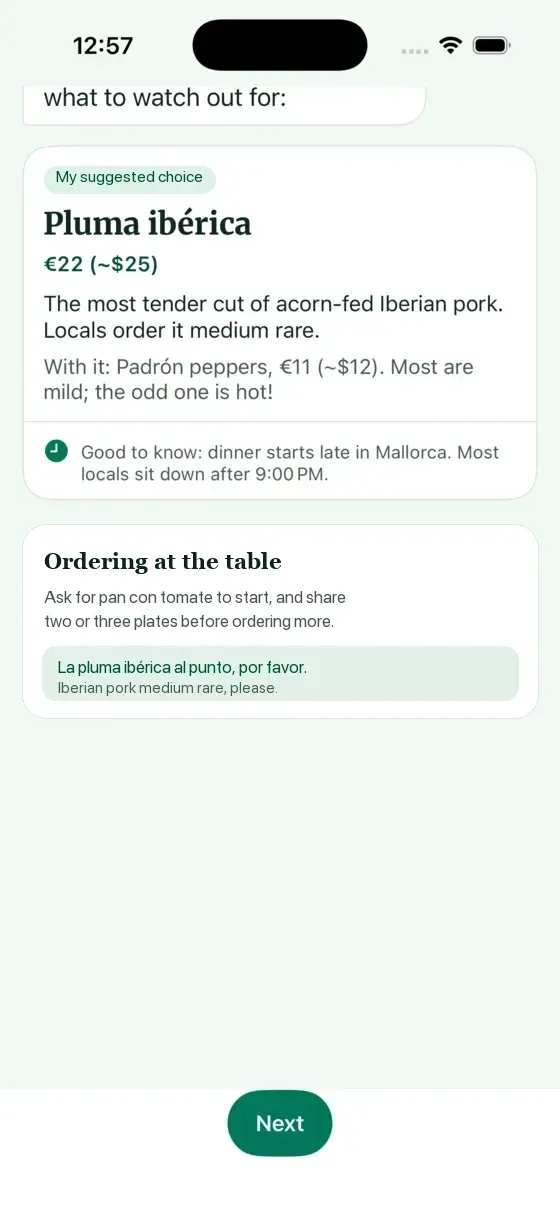
Put Ask Lucy on your iPhone Lock Screen (iPhone & iPad, iOS 26+) before sailing. Walk into a real side-street trattoria, konoba, or taverna and snap up to 4 photos in one turn — the daily specials chalkboard, printed menu, wine list, and fine-print cover-charge footer. Lucy translates the dishes in plain English, flags coperto, terraza supplements, or per kg fish traps, converts euros into Home-first prices ($21 (€18)) at live rates, and checks any allergies saved in your Profile (behind explicit Health consent) with four-state Safety verdicts (Safe, Caution, Unsafe, or Unknown).
Two quick port-day power moves: snap the restaurant’s Wi-Fi placard or your ship’s port shuttle schedule to pull a tappable Details card (Join Wi-Fi, Call, or Apple Maps Directions), and remember that Ask Lucy needs Wi-Fi or mobile data to reply — if signal drops inside a thick-walled Dubrovnik alley, photos queue automatically in her Offline outbox and send once signal returns. Keep downloaded offline packs in Apple Translate or Google Translate for dead zones, use their Conversation mode for live spoken back-and-forth with a taxi driver, and enjoy tasting the real Mediterranean with plenty of minutes to spare on the gangway.
Cards to say or show
Tap any Mediterranean port phrase card to show it full screen — covering daily local picks, avoiding per-kilogram fish bill shocks, and requesting the check in time for all-aboard.
Watch out for
- Never confuse all-aboard with ship departure: all-aboard is usually 30–60 minutes BEFORE sail-away, and the ship will leave without you if an afternoon taxi jams up leaving Marseille MPCT, Piraeus, or Dubrovnik's Pile Gate.
- Watch 'per kg' or 'per 100g' seafood pricing: in Croatia, Italy, and Greece, fresh whole fish or lobster listed as €85/kg (or €9/100g) can easily become a €70+ plate — always ask the fish's exact weight and euro total before it hits the grill.
- Know mandatory vs. declinable cover charges: Italian coperto (€1.50–€4 pp) is standard and mandatory whenever printed on the menu, whereas under Greek law (DI.E.P.P.Y. Art. 72), diners may politely decline unsolicited bread and water and pay €0 kouver (κουβέρ) — it is only charged when listed and accepted.
- Skip neon photo menus of paella on Las Ramblas or '€20 Bouillabaisse' on Vieux-Port: authentic paella is cooked fresh to order (and usually ordered for 2+), and authentic Marseillais bouillabaisse is a €65+ ceremony — cheap pier versions are almost always frozen reheats.
- Remember Europe never drops the bill while you are still chatting: waiters consider bringing the check unasked rude — catch their eye and ask 20 minutes before your walk back to the pier.
Common questions
Which Mediterranean cruise ports let you walk straight to great local food?
Naples (Stazione Marittima), Split, and Valletta are the easiest walk-off food ports in the Mediterranean — authentic pizzerias, Dalmatian konobas, and Maltese pastizzeriji sit within a 10–20 minute walk of the ship. Barcelona, Marseille, Athens (Piraeus), and Dubrovnik (Gruž) are still fantastic food stops, just allow 15–30 minutes each way for shuttles, buses, or metro (or eat right in Piraeus's Mikrolimano or Dubrovnik's Gruž Harbor).
How do I spot a cruise-port tourist trap in 10 seconds?
Four classic giveaways: (1) a greeter standing outside waving menus and pulling arms, (2) huge glossy boards showing photographs of dishes in six languages, (3) a schizophrenic menu selling pizza, paella, burgers, and nachos together, and (4) a half-empty terrace at peak local lunch hour (1:30–2:30 PM) when side-street spots two blocks away are packed with locals.
How much should I tip at Mediterranean cruise-port restaurants?
Far less than North America. In France, 15% service is legally built in (service compris — round up €1–€2 for great service). In Italy, coperto is a table fee, not a tip, yet leaving loose change or 5% is plenty. In Spain, Greece, and Croatia, rounding up or leaving 5–10% in cash for sit-down service is warmly appreciated and never mandatory.
What time should I start heading back to the cruise ship after lunch?
Work backward from ALL-ABOARD (usually 30–60 minutes before sailing). For walkable ports like Naples, Split, and Valletta, ask for the bill at least 60–75 minutes before all-aboard. For transit ports like Marseille (MPCT), Athens/Piraeus, Barcelona (Moll Adossat), or Dubrovnik Old Town, aim to wrap lunch and begin transit at least 90–120 minutes before all-aboard.
Can Ask Lucy translate menus in all seven Mediterranean port languages without switching settings?
Yes. You never have to pick a source language before shooting — point your iPhone camera at Italian, Spanish, Catalan, French, Greek, Croatian, or Maltese menus (up to 4 photos in one turn) and Lucy replies in your language with Home-first prices. Ask Lucy needs Wi-Fi or mobile data to generate answers (photos snapped in signal-free stone alleys queue in her Offline outbox until signal returns), so keep offline language packs in Apple or Google Translate as a dead-zone backup.