Allergies & Diets · Europe
European Supermarket Allergen Label Guide: EU 14 Bold Rules Across 7 Languages
Last updated
EU law makes grocery shopping across France, Italy, Spain, Germany, Portugal, the Netherlands, and Greece remarkably transparent — once you know how the 14 mandatory bolded allergens work, why 'May contain' warnings are NOT legally standardized, and what sneaky words like lupin and celery look like in seven languages.

On this page (11 sections)
- In short
- How it works
- How EU Regulation 1169/2011 Works Inside Every European Grocery Aisle
- The Complete 7-Language EU 14 Allergen Lookup Table
- Why “May Contain” (PAL) Warnings Are NOT Legally Standardized in Europe
- Four Sneaky European Grocery Traps to Catch Early
- Check Every Back-of-Pack Panel Fast with Ask Lucy
- Cards to show
- Watch out for
- Common questions
- Use Lucy on the spot
Reading European supermarket allergen labels in 30 seconds
Under EU Regulation (EU) No 1169/2011 (Annex II), every pre-packaged food across all 27 EU countries (and closely aligned UK, Swiss, and Norwegian markets) must emphasize 14 mandatory allergens right inside the ingredient list using bold, italics, ALL CAPS, or highlighting — do NOT hunt for a separate 'Contains:' summary box. Watch for EU triggers rarely bolded in North America (lupin, celery, mustard, and sulphites over 10 mg/kg or 10 mg/L), and remember 'May contain' precautionary traces (PAL) are voluntary and NOT legally standardized across Europe.
- The EU legal rule
- Regulation (EU) 1169/2011 (Annex II): 14 mandatory allergens highlighted inside ingredients
- No 'Contains:' box?
- Normal! EU rules highlight allergens directly in bold/CAPS inside the ingredient paragraph
- Sneaky EU-14 triggers
- Lupin (cross-reacts with peanuts!), celery, mustard, and sulphites (over 10 mg/kg or 10 mg/L)
- 'May contain' (PAL) reality
- Voluntary & NOT legally standardized — absence of a trace warning ≠ zero cross-contact
How it actually works on the spot
-
Scan the ingredient paragraph for BOLD or ALL-CAPS words first
Unlike US packaging that prints a bold 'Contains: Milk, Wheat' line underneath, European labels at Carrefour, Esselunga, Mercadona, Rewe, Pingo Doce, Albert Heijn, and Sklavenitis highlight each of the 14 allergens right inside the main ingredient text.
-
Check the specific nut, grain, and sneaky EU triggers (lupin, celery, mustard)
EU law requires listing the exact cereal (wheat, barley, rye, oats) and exact tree nut (hazelnut, almond, walnut, pistachio, cashew) in bold. Peanut-allergic shoppers should also scan closely for lupin flour (lupin / lupini / Lupinen / tremoços), widely used in European gluten-free breads and bakery items.
-
Read the trace / 'May contain' line separately below the ingredients
Look beneath the main paragraph for 'Peut contenir…' (FR), 'Può contenere…' (IT), 'Puede contener…' (ES), or 'Kann Spuren von…' (DE). Because Precautionary Allergen Labeling is voluntary in the EU, treat missing trace statements with caution for severe allergies.
-
Snap the whole back panel with Ask Lucy before tossing items in your basket
Save your exact Allergies and Severity in Ask Lucy's Profile (behind explicit Health consent) before your trip. Shoot up to 4 photos of the package front, fine-print ingredient block, and PAL line — Lucy reads all 7 languages and returns four-state Safety verdicts (Safe, Caution, Unsafe, or Unknown).
How EU Regulation 1169/2011 Works Inside Every European Grocery Aisle
Whether you are stocking up on train snacks at a Parisian Carrefour, hunting gluten-free pasta at Milan’s Esselunga, browsing Mercadona in Madrid, grabbing picnic cheese at Rewe or Edeka in Munich, or shopping at Pingo Doce (Lisbon), Albert Heijn (Amsterdam), or Sklavenitis (Athens), one law makes your life dramatically easier: EU Regulation (EU) No 1169/2011 (Annex II).
Across all 27 European Union member states — plus closely aligned standards in the UK, Switzerland, Norway, and Iceland — pre-packaged foods MUST visually emphasize 14 mandatory allergens right inside the ingredient list using bold, italics, ALL CAPS, or a contrasting background. Instead of squinting for a US-style “Contains:” box at the bottom (which EU rules actually prohibit when an ingredient block is already printed), your eyes jump straight to the highlighted words inside the paragraph — for example: “farine de BLÉ, LAIT écrémé, NOISETTES, lécithine de SOJA.”
The Complete 7-Language EU 14 Allergen Lookup Table
Screenshot this table before stepping into a European supermarket — it covers all 14 Annex II allergens across French (FR), Italian (IT), Spanish (ES), German (DE), Portuguese (PT), Dutch (NL), and Greek (EL):
| EU 14 Allergen | FR / IT / ES | DE / PT / NL | Greek (EL) |
|---|---|---|---|
| Gluten cereals | blé, orge, seigle, avoine / grano (frumento), orzo, segale, avena / trigo, cebada, centeno, avena | Weizen, Gerste, Roggen, Hafer, Dinkel / trigo, cevada, centeio, aveia / tarwe, gerst, rogge, haver, spelt | γλουτένη, σιτάρι, κριθάρι, σίκαλη, βρώμη |
| Milk / Lactose | lait, lactose, beurre, crème / latte, lattosio, burro, panna / leche, lactosa, mantequilla, nata | Milch, Laktose, Butter, Sahne, Molke / leite, lactose, manteiga, natas / melk, lactose, boter, room, wei | γάλα, λακτόζη, βούτυρο, κρέμα γάλακτος |
| Eggs | œufs / uova / huevos | Eier / ovos / eieren | αυγά (αβγά) |
| Peanuts | arachides (cacahuètes) / arachidi / cacahuetes | Erdnüsse / amendoins / pinda’s (aardnoten) | αραχίδες (αράπικα φιστίκια) |
| Tree nuts | fruits à coque (amandes, noisettes, noix, cajou, pistaches) / frutta a guscio (mandorle, nocciole, noci, anacardi) / frutos de cáscara (almendras, avellanas, nueces, anacardos) | Schalenfrüchte (Mandeln, Haselnüsse, Walnüsse, Cashewkerne) / frutos de casca rija (amêndoas, avelãs, nozes, cajus) / noten (amandelen, hazelnoten, walnoten, cashewnoten) | καρποί με κέλυφος (αμύγδαλα, φουντούκια, καρύδια, κάσιους, φιστίκια Αιγίνης) |
| Soy | soja / soia / soja | Soja / soja / soja | σόγια |
| Fish | poissons / pesce / pescado | Fisch / peixe / vis | ψάρια |
| Crustaceans | crustacés / crostacei / crustáceos | Krebstiere / crustáceos / schaaldieren | καρκινοειδή |
| Molluscs | mollusques / molluschi / moluscos | Weichtiere / moluscos / weekdieren | μαλάκια |
| Sesame | graines de sésame / semi di sesamo / granos de sésamo | Sesamsamen / sementes de sésamo / sesamzaad | σπόροι σησαμιού (σουσάμι) |
| Celery | céleri / sedano / apio | Sellerie / aipo / selderij | σέλινο |
| Mustard | moutarde / senape / mostaza | Senf / mostarda / mosterd | σινάπι (μουστάρδα) |
| Lupin | lupin / lupini / altramuces | Lupinen / tremoços / lupine | λούπινο |
| Sulphites (over 10 mg/kg or 10 mg/L) | sulfites / solfiti / sulfitos | Sulfite (Schwefeldioxid) / sulfitos / sulfieten | θειώδεις ενώσεις |
Why “May Contain” (PAL) Warnings Are NOT Legally Standardized in Europe
Here is the single biggest nuance travelers miss after praising EU bolding: EU Regulation 1169/2011 covers intentional ingredients ONLY. Precautionary Allergen Labeling (PAL) — the trace warning sitting beneath the ingredient list — is voluntary and NOT legally standardized across the European Union.
Know the exact local phrases to spot right under every ingredient paragraph:
- French: Peut contenir des traces de… / Fabriqué dans un atelier qui utilise…
- Italian: Può contenere tracce di… / Prodotto in uno stabilimento che utilizza…
- Spanish: Puede contener trazas de…
- German: Kann Spuren von … enthalten
- Portuguese: Pode conter vestígios de…
- Dutch: Kan sporen van … bevatten
- Greek: Μπορεί να περιέχει ίχνη από…
Because no single EU threshold forces brands to print (or omit) PAL, two truths apply together: a trace line does not reveal actual risk levels, and no “May contain” line does NOT guarantee a dedicated allergen-free factory. For severe allergies, stick to audited free-from ranges (like Italy’s AIC crossed-grain seal or Spain’s Mercadona Sin Gluten lines — see our Italy and Spain celiac guides) alongside your allergist’s advice.
Four Sneaky European Grocery Traps to Catch Early
- Lupin (lupin / lupini / Lupinen / tremoços): Rare in North American groceries, lupin flour appears constantly in European gluten-free breads, waffles, and plant-based mixes — and cross-reacts with peanut allergies.
- Celery & Mustard everywhere: Stock cubes, instant soups, deli meats, and dressings across Germany, France, and the Netherlands lean heavily on celery (Sellerie) and mustard (moutarde / Senf).
- Tree nuts vs. Peanuts: EU law bolds the exact nut (noisettes, mandorle, anacardos, Walnüsse) inside the paragraph. Double-check French noisette (hazelnut) vs noix (walnut), and Castilian Spanish cacahuetes (peanuts) vs frutos de cáscara (tree nuts).
- Deli & bakery counters: Stores must hold allergen sheets (ficha de alérgenos / Allergenliste) for unwrapped items, yet shared tongs and meat slicers create heavy cross-contact — choose factory-sealed packets when risk must stay low.
Check Every Back-of-Pack Panel Fast with Ask Lucy
Squinting at 5-point multilingual print under grocery lights while holding a basket gets old fast — especially when one chocolate bar packs six languages in one block.
Before flying, open Ask Lucy on your iPhone or iPad (iOS 26+ — 1 free photo scan included with no card, then a 3-day free trial on Weekly $5.99, Monthly $9.99, or Yearly $39.99). Save your Allergies and Severity (mild, moderate, or severe) in your Profile behind explicit one-tap Health consent (Lucy never passively guesses health data). Optional Diet (vegetarian, vegan, pescatarian, gluten-free — not Health data) and Pregnancy (behind Health consent) shape replies automatically without verdict cards.
In the aisle, snap up to 4 photos in one turn — front label, ingredient paragraph, and tiny PAL line. Blurry and Too dark flags warn you before sending if shiny foil text isn’t sharp. Lucy reads every bolded EU-14 trigger and trace line and returns explicit four-state Safety verdicts (Safe, Caution, Unsafe, or Unknown — skipped or unreadable checks stay Unknown, never Safe). Signal drop inside a concrete hypermarket? Snaps queue in Lucy’s Offline outbox until signal returns — keep downloaded Apple Translate (FR/IT/ES/DE/NL, plus Brazilian Portuguese) or Google Translate (covering Greek and European Portuguese as well!) offline packs as your dead-zone backup.
Cards to say or show
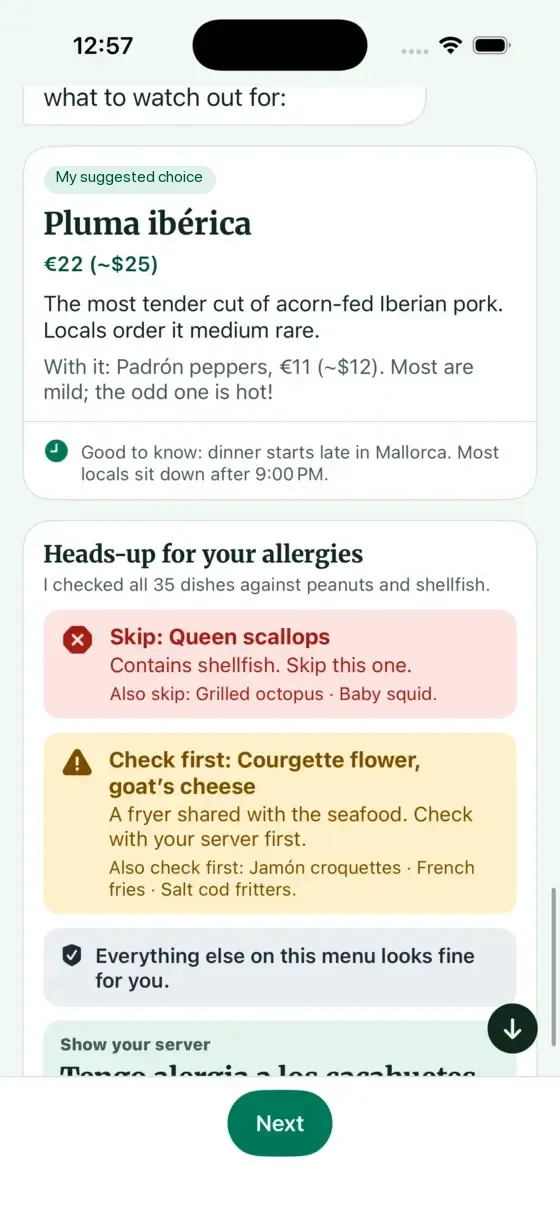
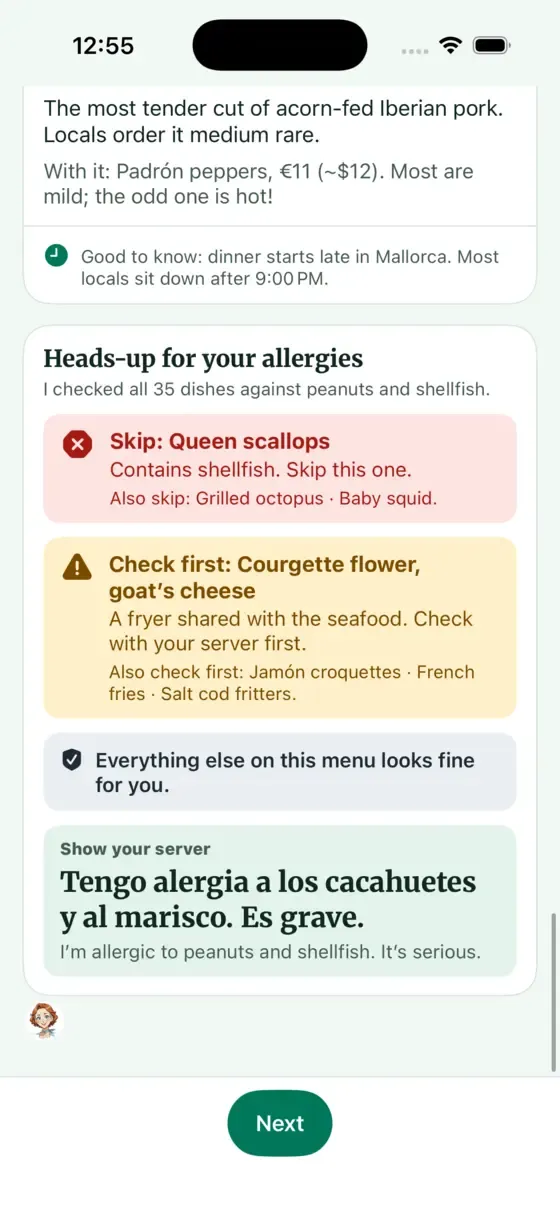
Tap any card to show it full screen to supermarket staff at Carrefour, Esselunga, Mercadona, or Rewe/Edeka — especially at bakery and deli counters.
Watch out for
- 'May contain' / Precautionary Allergen Labeling (PAL) is NOT legally standardized in the EU: manufacturers choose voluntarily whether to print 'Kann Spuren von… enthalten' or 'Peut contenir des traces de…' — an item with NO trace warning is not automatically cross-contact-free, and a warning does not tell you actual trace amounts.
- Peanut-allergic travelers MUST watch for lupin: one of Europe's 14 bolded allergens (lupin, lupini, altramuces, Lupinen, tremoços, lupine, λούπινο), lupin beans and flour hide in European gluten-free breads, pasta, pastries, and Portuguese café snacks — and share strong cross-reactivity with peanuts.
- Never assume a missing 'Contains:' box means allergen-free: EU Regulation 1169/2011 actually forbids redundant 'Contains:' boxes when an ingredient list is present — allergens appear strictly via bold, italics, or ALL CAPS inside the paragraph itself.
- Watch 'gluten-free wheat starch' on European celiac shelves: certified crossed-grain products in Italy, Germany, and Spain sometimes use Codex-compliant gluten-free wheat starch (below 20 ppm gluten) — safe for many celiac diners, yet UNSAFE for anyone with a true wheat allergy!
- Fresh supermarket bakeries and deli counters carry high cross-contact risk: although EU law requires stores to hold allergen sheets for unwrapped foods, shared bread slicers, tongs, and cheese knives routinely transfer nuts, sesame, gluten, and dairy.
Common questions
What are the 14 mandatory food allergens under EU Regulation 1169/2011?
Annex II of EU Regulation (EU) No 1169/2011 mandates clear visual emphasis (bold, italics, ALL CAPS, or contrast) inside ingredient lists for 14 allergen groups: (1) cereals containing gluten (wheat, rye, barley, oats, spelt, kamut), (2) crustaceans, (3) eggs, (4) fish, (5) peanuts, (6) soybeans, (7) milk/lactose, (8) tree nuts (almonds, hazelnuts, walnuts, cashews, pecans, Brazil nuts, pistachios, macadamias), (9) celery, (10) mustard, (11) sesame seeds, (12) sulphur dioxide & sulphites at concentrations over 10 mg/kg or 10 mg/L, (13) lupin, and (14) molluscs.
Why don't European food packages have a separate 'Contains:' summary line?
Under EU Regulation 1169/2011, allergens must be emphasized directly inside the main ingredient list (for example, 'farine de BLÉ, BEURRE, NOISETTES'). EU guidance actually prohibits repeating a separate 'Contains:' list alongside an ingredient block because shoppers might read only the summary and miss details. Separate 'Contains:' statements are only used on tiny items without full ingredient lists (such as wine bottles listing 'Contains sulphites').
Is 'May contain traces of…' legally regulated across the European Union?
No. Precautionary Allergen Labeling (PAL) — phrases like 'Peut contenir des traces de', 'Può contenere tracce di', 'Puede contener trazas de', or 'Kann Spuren von ... enthalten' — remains voluntary and lacks harmonized EU threshold limits. Some conscientious manufacturers skip PAL only after rigorous cleaning, while others omit it simply because it is optional. Travelers with severe allergies should evaluate risk alongside their allergist's advice.
Which European supermarket chains are easiest for allergy and gluten-free shopping?
Spain's Mercadona is famously easy for travelers thanks to crisp, color-coded 'Sin Gluten' and 'Sin Lactosa' badges across its Hacendado house brand. Italy's Esselunga, Coop, and Conad stock huge aisles of AIC-certified 'Senza Glutine' pasta and pastries. Germany's Rewe, Edeka, and dm drugstores carry deep 'Frei von' ranges, France's Carrefour and Monoprix offer dedicated bio/sans-gluten bays, and Albert Heijn (Netherlands), Pingo Doce (Portugal), and Sklavenitis (Greece) all follow uniform EU-14 bolding.