
Spain, most of Latin America, Equatorial Guinea
Essential Spanish Phrases for Travelers
Last updated March 29, 2026
Spanish is the second most spoken native language in the world, and learning even basic phrases will serve you across more than 20 countries. In Spain specifically, attempting Spanish — even badly — earns you genuine goodwill. The language is phonetic and consistent, making pronunciation straightforward once you learn a handful of rules.
Why Learn Spanish Phrases for Travel?
Spanish is arguably the single most useful travel language after English. With basic Spanish, you can communicate in Spain, Mexico, Central America, most of South America, and parts of the Caribbean. The language is phonetic — what you see is what you say — and even a dozen well-pronounced phrases will dramatically improve your travel experience.
In Spain specifically, the culture rewards social warmth. A simple 'Buenos dias' when entering a shop, or 'Gracias' when receiving your coffee, creates a connection that changes how people interact with you. You stop being a tourist and start being a guest.
Spain vs Latin American Spanish
The Spanish spoken in Spain differs from Latin American Spanish in pronunciation, vocabulary, and some grammar. The most noticeable difference is the 'th' sound: in Spain, 'cerveza' is 'thehr-VEH-thah', while in Latin America it's 'sehr-VEH-sah'. Both are correct. If you learn one version, you'll be understood everywhere — the differences are like British vs American English.
Navigating Spanish Menus
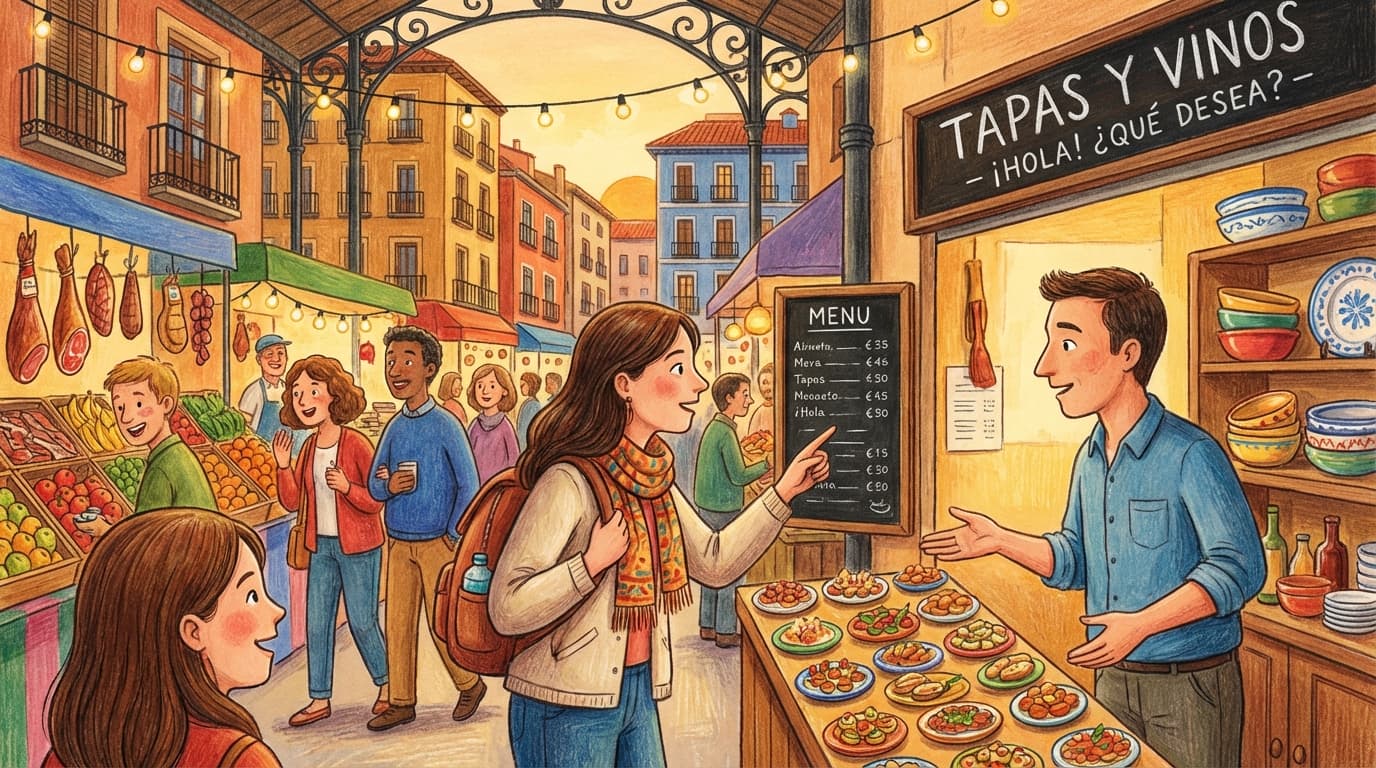
Spanish dining culture revolves around sharing. Tapas (small plates) are the norm in bars — order several and share the table. A 'menu del dia' (menu of the day) is a fixed-price lunch special found at most restaurants, typically offering a starter, main, dessert, and drink for 10-15 euros. It's the best value meal in Spain and often better quality than the a la carte options.
Essential Phrases
| Phrase | English | Pronunciation |
|---|---|---|
| Hola | Hello | OH-lah |
| Buenos dias | Good morning | BWAY-nos DEE-as |
| Buenas tardes | Good afternoon | BWAY-nas TAR-des |
| Por favor | Please | por fah-VOR |
| Gracias | Thank you | GRAH-thee-as (Spain) / GRAH-see-as (Latin America) |
| Lo siento | I'm sorry | loh see-EN-toh |
| Donde esta...? | Where is...? | DON-deh es-TAH |
| Cuanto cuesta? | How much does it cost? | KWAN-toh KWES-tah |
| No entiendo | I don't understand | noh en-tee-EN-doh |
| Habla ingles? | Do you speak English? | AH-blah een-GLES |
Dining & Restaurant Phrases
| Phrase | English | Pronunciation |
|---|---|---|
| Una mesa para dos | A table for two | OO-nah MEH-sah PAH-rah dos |
| La cuenta, por favor | The bill, please | lah KWEN-tah, por fah-VOR |
| Que nos recomienda? | What do you recommend? | keh nos reh-koh-mee-EN-dah |
| Soy alergico/a a... | I am allergic to... | soy ah-LEHR-hee-koh ah |
| Una cerveza, por favor | A beer, please | OO-nah thehr-VEH-thah por fah-VOR |
| Agua sin gas / con gas | Still / sparkling water | AH-gwah seen gas / kon gas |
Emergency Phrases
| Phrase | English | Pronunciation |
|---|---|---|
| Ayuda! | Help! | ah-YOO-dah |
| Necesito un medico | I need a doctor | neh-seh-SEE-toh oon MEH-dee-koh |
| Llame a la policia | Call the police | YAH-meh ah lah poh-lee-THEE-ah |
| Donde esta el hospital? | Where is the hospital? | DON-deh es-TAH el os-pee-TAHL |
Cultural Notes
- •In Spain, lunch is the main meal (2-4pm) and dinner is late (9-11pm). Many restaurants don't open for dinner until 8:30pm. Adjust your eating schedule or you'll find everything closed.
- •Spaniards use the 'th' sound for C before E/I and for Z — 'Barcelona' sounds like 'Bar-theh-LOH-nah'. This is not a lisp; it's standard Castilian pronunciation.
- •Tipping in Spain is modest. Rounding up the bill or leaving 5-10% is generous. Service charge is included in prices.
- •The siesta is real in smaller towns. Shops typically close from 2-5pm. Plan museum visits and shopping around this schedule.