
Poland
Essential Polish Phrases for Travelers
Last updated March 29, 2026
Polish is a Slavic language that looks intimidating on paper — clusters of consonants like 'szcz' and 'prz' seem unpronounceable at first glance. But Polish pronunciation follows strict, consistent rules, and once you learn the letter combinations, it becomes much more manageable. Polish people are incredibly warm to visitors who attempt their language, and even basic phrases earn enormous goodwill.
Why Learn Polish Phrases for Travel?
Poland is one of Europe's best-value destinations, with extraordinary food, beautiful cities, and warm hospitality. English proficiency is growing, especially among younger Poles, but Polish phrases are genuinely appreciated and sometimes necessary in smaller towns and traditional restaurants. The effort of learning even a few words is noticed and rewarded with warmth.
Cracking the Pronunciation Code
Polish consonant clusters look terrifying but follow consistent rules. SZ = 'sh', CZ = 'ch', SI = soft 'sh', CI = soft 'ch', RZ/Z-dot = 'zh' (like the S in 'pleasure'), DZ = 'dz', DZ-dot/DRZ = 'j', L-stroke = 'w', W = 'v'. Once you internalize these combinations, Polish becomes readable. The stress almost always falls on the second-to-last syllable.
Eating in Poland
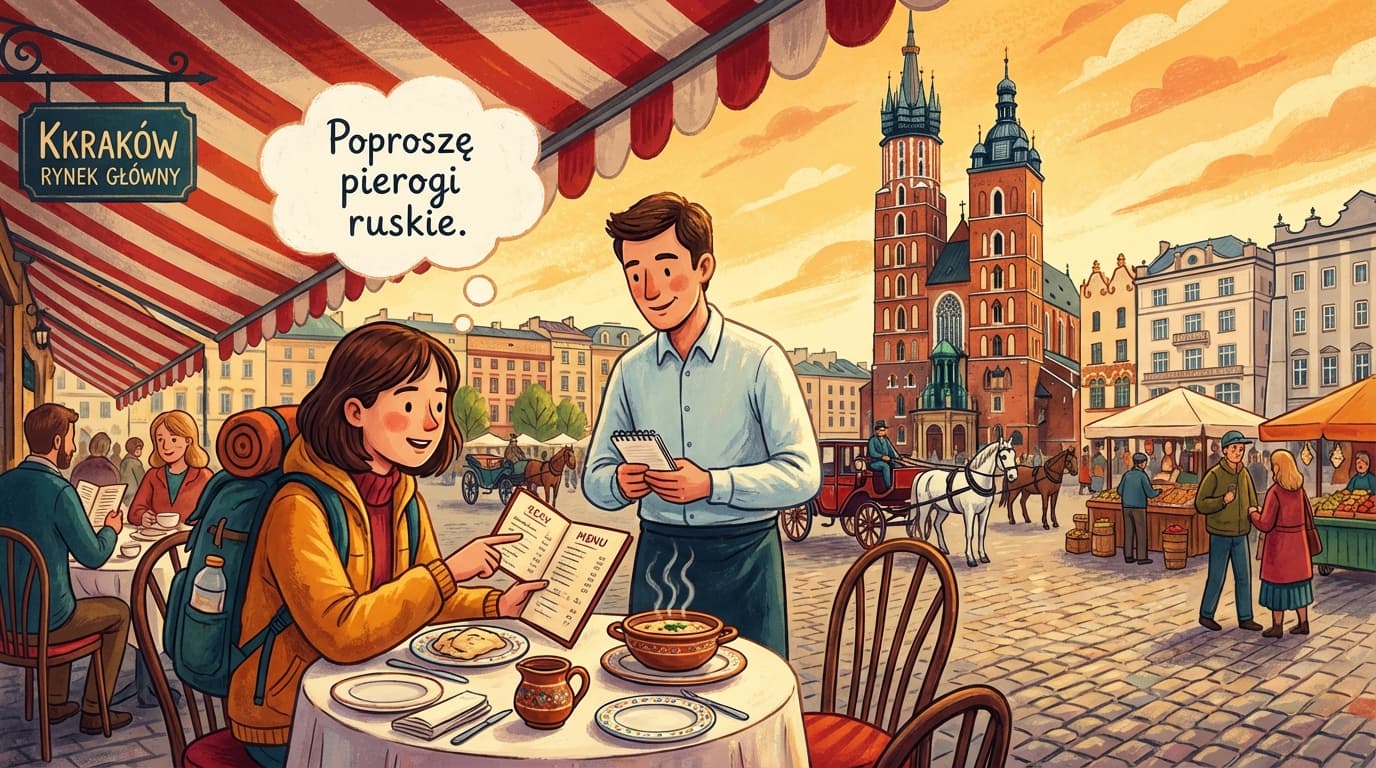
Polish cuisine is comfort food at its finest. Pierogi are the national dish — dumplings filled with potato and cheese (ruskie), meat, sauerkraut and mushroom, or seasonal fruits. Zurek (sour rye soup served in a bread bowl) is Poland's most distinctive soup. Bigos (hunter's stew of sauerkraut, various meats, and mushrooms) is a slow-cooked masterpiece. Pair everything with Polish beer or a shot of Zubrowka. A full meal at a traditional restaurant costs 8-15 euros, making Poland one of Europe's best food destinations for value.
Essential Phrases
| Phrase | English | Pronunciation |
|---|---|---|
| Dzien dobry | Good day / Hello (formal) | jen DOH-bri |
| Czesc | Hi / Bye (informal) | cheshch |
| Do widzenia | Goodbye | doh vee-DZEN-yah |
| Prosze | Please / Here you go | PROH-sheh |
| Dziekuje | Thank you | jen-KOO-yeh |
| Przepraszam | Excuse me / Sorry | psheh-PRAH-shahm |
| Gdzie jest...? | Where is...? | g-JEH yest |
| Ile to kosztuje? | How much does it cost? | EE-leh toh kosh-TOO-yeh |
| Nie rozumiem | I don't understand | nyeh roh-ZOO-myem |
| Czy mowi Pan/Pani po angielsku? | Do you speak English? | chi MOO-vee pahn/PAH-nee poh ahn-GYEL-skoo |
Dining & Restaurant Phrases
| Phrase | English | Pronunciation |
|---|---|---|
| Rachunek, prosze | The bill, please | rah-HOON-ek, PROH-sheh |
| Stolik dla dwoch osob | A table for two | STOH-leek dlah dvooh oh-SOOB |
| Co poleca Pan/Pani? | What do you recommend? | tsoh poh-LEH-tsah pahn/PAH-nee |
| Jestem uczulony/a na... | I am allergic to... | YES-tem oo-choo-LOH-ni nah |
| Jedno piwo, prosze | One beer, please | YED-noh PEE-voh, PROH-sheh |
| Na zdrowie! | Cheers! (To health!) | nah ZDROV-yeh |
Emergency Phrases
| Phrase | English | Pronunciation |
|---|---|---|
| Pomocy! | Help! | poh-MOH-tsi |
| Potrzebuje lekarza | I need a doctor | poh-TSHEH-boo-yeh leh-KAH-zhah |
| Prosze zadzwonic na policje | Please call the police | PROH-sheh zah-DZVOH-neetch nah poh-LEETS-yeh |
| Gdzie jest szpital? | Where is the hospital? | g-JEH yest SHPEE-tahl |
Cultural Notes
- •Poland uses Pan (Mr) and Pani (Mrs/Ms) as formal address — the equivalent of using 'Sir' or 'Madam' in English. Use these when speaking to anyone you don't know well.
- •Vodka is the national drink, but Poland also has a thriving craft beer scene. Zubrowka (bison grass vodka) served with apple juice is a classic combination.
- •Polish cuisine is hearty and affordable. Pierogi (dumplings), zurek (sour rye soup), bigos (hunter's stew), and placki ziemniaczane (potato pancakes) are essential dishes.
- •Tipping 10% is customary at restaurants. Some restaurants add a service charge — check the bill before tipping extra.