
Germany, Austria, Switzerland, Liechtenstein, Luxembourg
Essential German Phrases for Travelers
Last updated March 29, 2026
German is English's closest major language relative, and you'll find many familiar words once you start looking. While Germans often speak excellent English, using German phrases shows respect and can lead to more authentic interactions, especially in smaller towns, beer gardens, and traditional restaurants where English is less common.
Why Learn German Phrases for Travel?
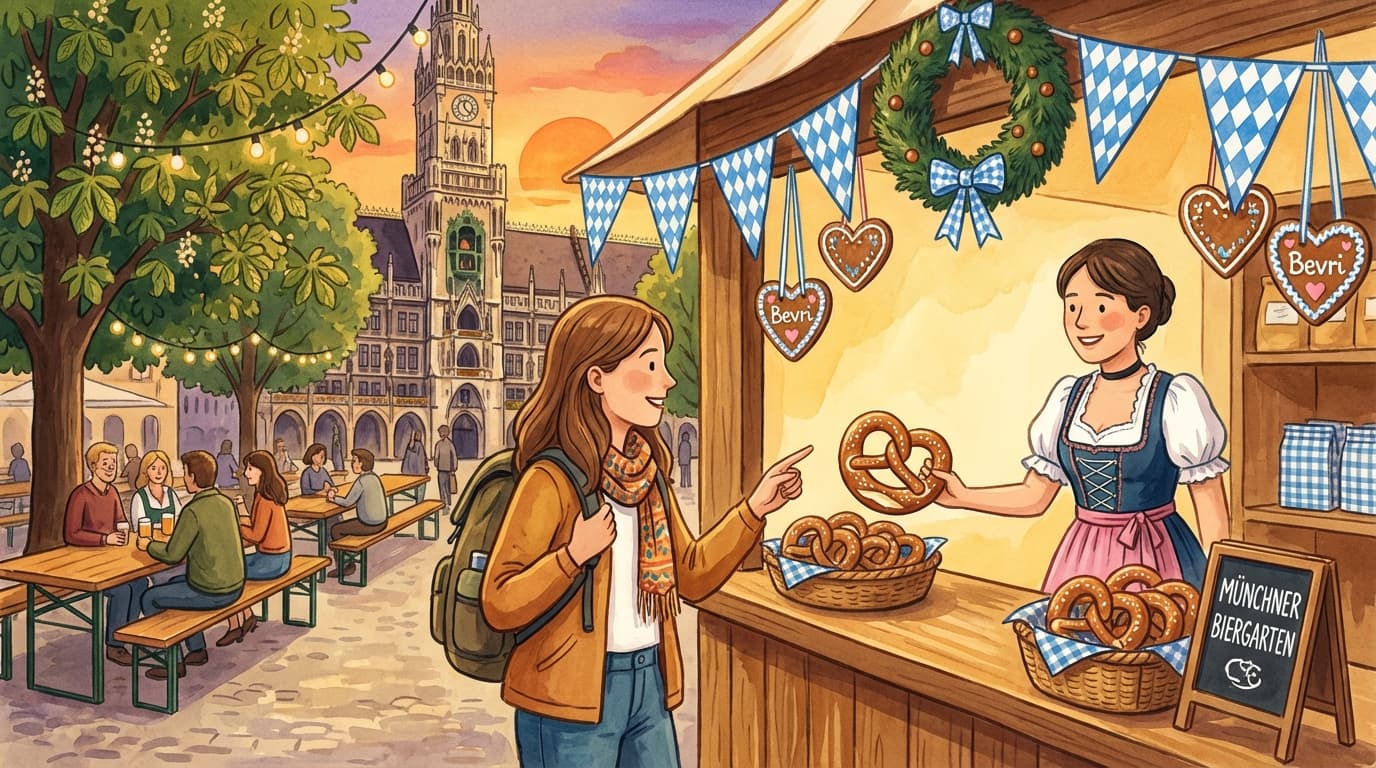
Germany has one of the highest English proficiency rates in Europe, especially among younger people. So why learn German? Because the experience changes when you try. Ordering 'Ein Bier, bitte' at a Munich beer hall, greeting someone with 'Guten Tag' in a Black Forest village, or thanking your waiter with 'Danke schon' — these small gestures create warmth and connection that English alone doesn't achieve.
Pronunciation Tips
German pronunciation is very regular — once you learn the rules, you can pronounce any word. Key sounds: W is pronounced like English V. V is pronounced like English F. Z is pronounced like 'ts'. CH after A, O, U is a throat sound like Scottish 'loch'. CH after E, I is softer, like 'sh' in some dialects. The U-umlaut sound (round your lips to say 'oo' while trying to say 'ee') and O-umlaut (round lips for 'oo' while saying 'eh') have no English equivalents — just approximate them.
Beer Culture Essentials
Germany takes beer seriously. Each region has its specialities: Weissbier (wheat beer) in Bavaria, Kolsch in Cologne, Alt in Dusseldorf, Pilsner in the north. In a beer hall, order by size: 'eine Mass' (one litre) or 'ein halbes' (half litre). The Reinheitsgebot (purity law) means German beer uses only water, hops, malt, and yeast. Tip by rounding up — tell the server the total you want to pay when they come to collect.
Essential Phrases
| Phrase | English | Pronunciation |
|---|---|---|
| Guten Morgen | Good morning | GOO-ten MOR-gen |
| Guten Tag | Good day / Hello | GOO-ten tahk |
| Auf Wiedersehen | Goodbye | owf VEE-dehr-zay-en |
| Bitte | Please / You're welcome | BIT-teh |
| Danke (schon) | Thank you (very much) | DAHN-keh (shurn) |
| Entschuldigung | Excuse me / Sorry | ent-SHOOL-dee-goong |
| Wo ist...? | Where is...? | voh ist |
| Was kostet das? | How much does this cost? | vahs KOS-tet dahs |
| Ich verstehe nicht | I don't understand | ikh fehr-SHTAY-eh nikht |
| Sprechen Sie Englisch? | Do you speak English? | SHPREH-khen zee ENG-lish |
Dining & Restaurant Phrases
| Phrase | English | Pronunciation |
|---|---|---|
| Die Rechnung, bitte | The bill, please | dee REKH-noong, BIT-teh |
| Einen Tisch fur zwei | A table for two | EYE-nen tish foor tsvye |
| Was empfehlen Sie? | What do you recommend? | vahs em-PFAY-len zee |
| Ich bin allergisch gegen... | I am allergic to... | ikh bin ah-LEHR-gish GAY-gen |
| Ein Bier, bitte | A beer, please | eyen beer, BIT-teh |
| Prost! | Cheers! | prohst |
Emergency Phrases
| Phrase | English | Pronunciation |
|---|---|---|
| Hilfe! | Help! | HIL-feh |
| Ich brauche einen Arzt | I need a doctor | ikh BROW-kheh EYE-nen artst |
| Rufen Sie die Polizei | Call the police | ROO-fen zee dee poh-lee-TSYE |
| Wo ist das Krankenhaus? | Where is the hospital? | voh ist dahs KRAN-ken-house |
Cultural Notes
- •Germans are punctual. If you have a reservation or appointment, arrive on time. Being even 5 minutes late is noticed and considered disrespectful.
- •In restaurants, you share tables with strangers at beer halls and busy restaurants. A simple 'Ist hier noch frei?' (Is this seat free?) is all you need.
- •Cash is more important in Germany than most European countries. Many restaurants and shops don't accept credit cards. Always carry euros.
- •When clinking glasses for 'Prost!', make eye contact with each person. German superstition says failing to do so brings seven years of bad luck.