
Iran, Afghanistan (as Dari), Tajikistan (as Tajik)
Essential Farsi/Persian Phrases for Travelers
Last updated March 29, 2026
Farsi (Persian) is a beautiful, poetic language with a rich literary tradition spanning millennia. Despite using a modified Arabic script, Farsi is actually an Indo-European language — more closely related to English than to Arabic. Iranian hospitality (ta'arof) is legendary, and even basic Farsi phrases unlock a warmth and generosity that will define your travel experience.
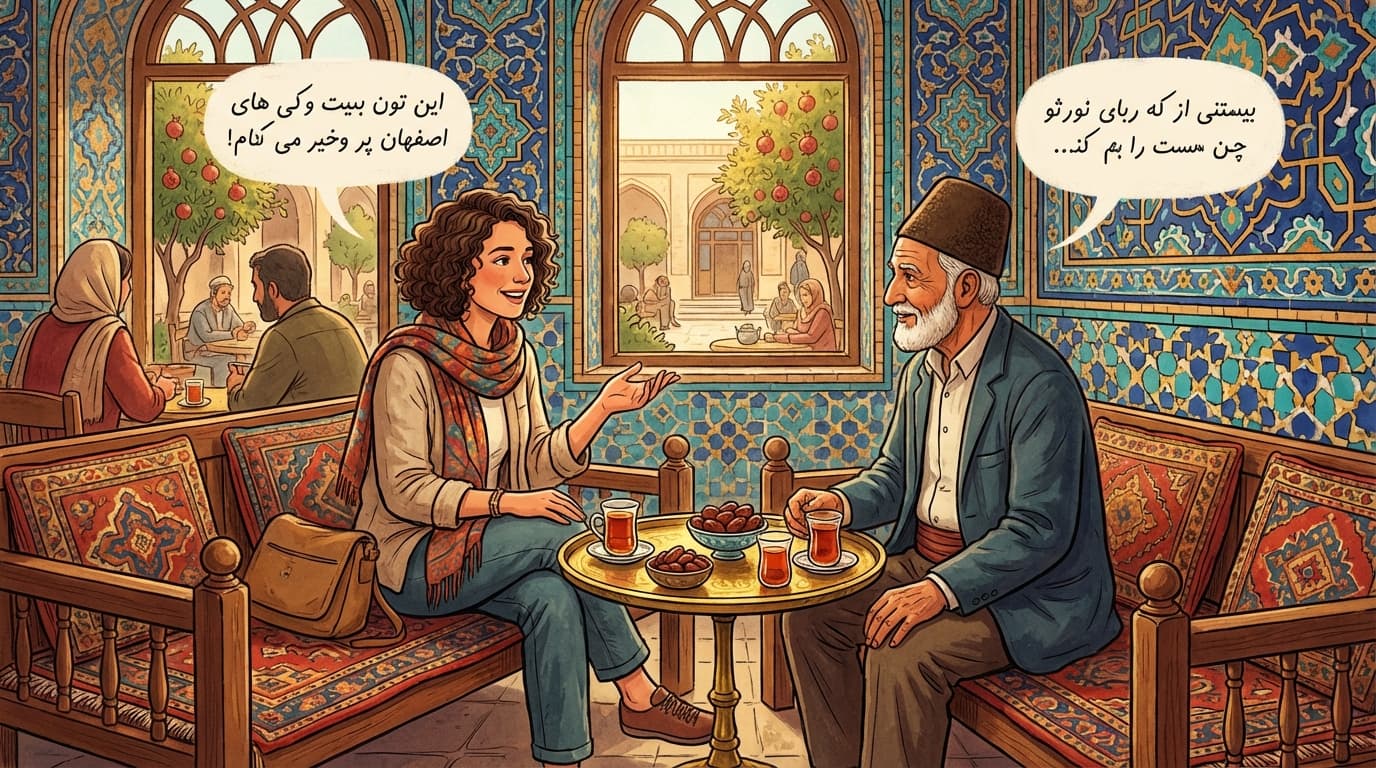
Why Learn Farsi Phrases for Travel?
Iran is one of the world's most misunderstood countries and one of its most rewarding to visit. The gap between media perception and reality is vast — Iranian hospitality is overwhelming, the culture is ancient and sophisticated, and the people are genuinely eager to connect with foreign visitors. Speaking even basic Farsi amplifies this welcome exponentially. Iranians are proud of their language and literature, and any attempt to speak Farsi is met with delight.
Farsi Pronunciation
Farsi has several sounds not found in English. KH (like 'ch' in Scottish 'loch') and GH (a gargled sound) are the most challenging. The Q sound is like K but deeper in the throat. Vowels include six sounds: A (short, like 'cut'), A-long (like 'father'), E (like 'pet'), I (like 'bee'), O (like 'go'), and U (like 'food'). Stress usually falls on the last syllable. Farsi is much more melodic than Arabic — listen for the flowing, poetic rhythm.
Eating in Iran
Persian cuisine is one of the world's great culinary traditions — refined over 2,500 years. Kebab (chelo kabab — saffron rice with grilled meat) is the national dish. Ghormeh sabzi (herb stew), fesenjan (pomegranate and walnut stew with chicken), and tahdig (the golden, crispy rice crust from the bottom of the pot — the best part) are essential. Iranian sweets are extraordinary: saffron ice cream, baklava, and gaz (Persian nougat). Every meal begins and ends with tea.
Essential Phrases
| Phrase | English | Pronunciation |
|---|---|---|
| Salam | Hello | sah-LAHM |
| Sobh bekheir | Good morning | sobh beh-KHAYR |
| Mamnun / Mersi | Thank you | mahm-NOON / mer-SEE |
| Lotfan | Please | lot-FAHN |
| Bebakhshid | Excuse me / Sorry | beh-BAHKH-sheed |
| Baleh / Na | Yes / No | bah-LEH / nah |
| ...kojast? | Where is...? | koh-JAHST |
| Chand? | How much? | chahnd |
| Nemifahmam | I don't understand | neh-mee-FAH-mahm |
Dining & Restaurant Phrases
| Phrase | English | Pronunciation |
|---|---|---|
| Surat hesab lotfan | The bill, please | soo-RAHT heh-SAHB lot-FAHN |
| Kheili khoshmaze! | Very delicious! | KHAY-lee khohsh-MAH-zeh |
| Bedun-e tond | Without spicy | beh-DOON-eh tohnd |
| Chai lotfan | Tea, please | CHY lot-FAHN |
| Nush-e jan! | Bon appetit! (May it nourish your soul) | noosh-eh JAHN |
Emergency Phrases
| Phrase | English | Pronunciation |
|---|---|---|
| Komak! | Help! | koh-MAHK |
| Doktor lazem daram | I need a doctor | DOK-tor LAH-zem DAH-rahm |
| Polis ra seda bezanid | Call the police | poh-LEES rah seh-DAH beh-zah-NEED |
| Bimarestan kojast? | Where is the hospital? | bee-mah-res-TAHN koh-JAHST |
Cultural Notes
- •Ta'arof is the Persian art of courtesy and ritual politeness. When offered food, drink, or a service, you are expected to decline at least once before accepting. The offerer insists, you decline, they insist again — then accept. This is not a game; it's a sincere exchange of respect.
- •Iran is an Islamic republic with strict dress codes. Women must wear a headscarf in public and cover their arms and legs. Men should avoid shorts in public.
- •Alcohol is illegal in Iran. Tea (chai) and non-alcoholic beverages are the social drinks. Iranian tea culture is rich and central to daily life.
- •Iranians are among the most hospitable people on earth. You will be invited into homes, offered meals by strangers, and helped far beyond expectation. This hospitality is genuine, not a scam.