
Egypt
Essential Arabic (Egyptian) Phrases for Travelers
Last updated March 29, 2026
Egyptian Arabic is the most widely understood Arabic dialect, thanks to Egypt's film and music industry. It differs significantly from Modern Standard Arabic and from Gulf Arabic, but it's understood across the Arab world. For travellers visiting Cairo, Luxor, and the Nile, Egyptian Arabic phrases are invaluable — they show respect, help with bargaining, and create connections that English alone cannot.
Why Learn Egyptian Arabic for Travel?
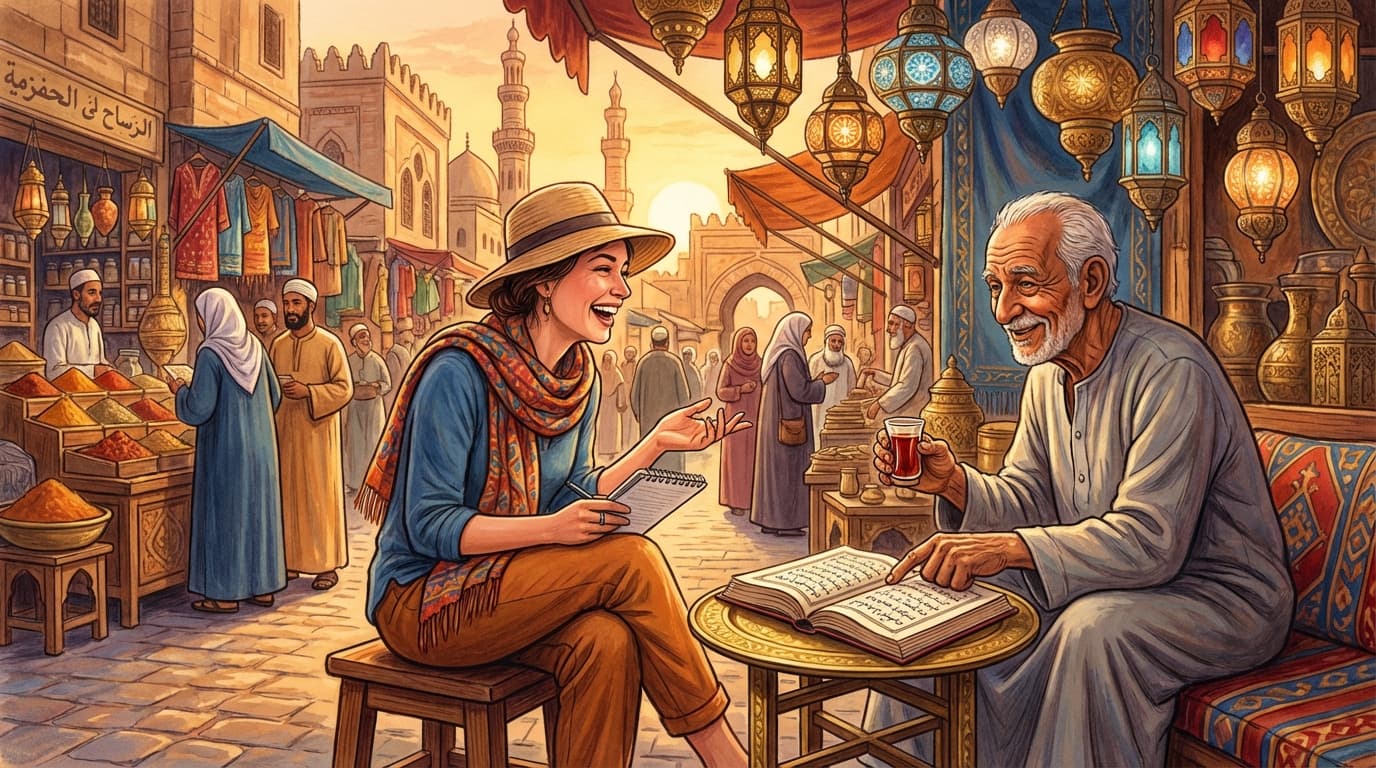
Egypt is a country where relationships and social warmth define every interaction. A few Arabic phrases — even just 'Shukran' and 'Assalamu alaykum' — change the dynamic entirely. At the Khan el-Khalili bazaar, in a felucca on the Nile, or at a local kushari restaurant, speaking Arabic transforms you from a tourist to a guest. Egyptian Arabic is also the most understood dialect across the Arab world, making these phrases useful far beyond Egypt.
Egyptian Arabic Pronunciation
Egyptian Arabic has several sounds unfamiliar to English speakers. The ain is a deep throat sound with no English equivalent — foreigners often skip it, and that's okay. The kha is like the 'ch' in Scottish 'loch'. The ghain is a gargled R. The ha is a breathy H from deep in the throat. Don't worry about perfecting these — approximate them and move on. Egyptians are very patient with foreign accents.
Eating in Egypt
Egyptian food is hearty, flavourful, and largely vegetarian-friendly. Kushari (rice, lentils, pasta, and crispy onions with tomato sauce and garlic vinegar) is the national street food — filling and cheap. Ful medames (slow-cooked fava beans), ta'meya (Egyptian falafel, made with fava beans rather than chickpeas), and shawarma are everywhere. For a proper meal, try molokhia (jute leaf soup), stuffed pigeon, and grilled kofta. Egyptian bread (aish baladi) is served with every meal and used as an edible utensil.
Essential Phrases
| Phrase | English | Pronunciation |
|---|---|---|
| Assalamu alaykum | Peace be upon you (universal greeting) | as-sah-LAH-moo ah-LAY-koom |
| Ahlan | Hello (informal) | AH-lan |
| Shukran | Thank you | SHOO-krahn |
| Aiwa / La | Yes / No | EYE-wah / lah |
| Min fadlak/ik | Please (to male/female) | min FAHD-lahk / FAHD-lik |
| Fein...? | Where is...? | feyn |
| Bi kam da? | How much is this? | bee-KAHM dah |
| Ghali awi | Very expensive | GAH-lee AH-wee |
| Mish fahem/fahma | I don't understand (m/f) | mish FAH-hem / FAH-mah |
| Insha'Allah | God willing (used constantly) | in-SHAH-ah-lah |
Dining & Restaurant Phrases
| Phrase | English | Pronunciation |
|---|---|---|
| El hisab law samaht | The bill, please | el hee-SAHB low sah-MAHT |
| Helw awi! | Very delicious! | HEL-oo AH-wee |
| Min gheir harr | Without spicy | min GEAR hahr |
| Mayya min fadlak | Water, please | MY-yah min FAHD-lahk |
| Shai bi na'na' | Mint tea | shy bee nah-NAH |
| Da eih? | What is this? | dah AY |
Emergency Phrases
| Phrase | English | Pronunciation |
|---|---|---|
| Elna'gda! | Help! | el-NAHG-dah |
| Ayez/a doktor | I need a doctor (m/f) | AH-yez DOK-tor |
| Ittasal bil bolis | Call the police | it-TAH-sal bil boh-LEES |
| Fein el mustashfa? | Where is the hospital? | feyn el mos-TASH-fah |
Cultural Notes
- •Insha'Allah (God willing) is used constantly and can mean anything from 'definitely yes' to 'probably not'. Context and tone reveal the true meaning.
- •Bargaining is a social art in Egypt, not just a transaction. Start at 30-40% of the asking price at bazaars, be friendly, drink tea if offered, and walk away if the price isn't right — the seller will often call you back.
- •Egyptians are extraordinarily hospitable. If invited for tea or food, accept if possible. Refusing can be seen as a rejection of friendship.
- •Dress modestly, especially when visiting mosques and religious sites. Women should carry a scarf. Remove shoes before entering mosques.