
Denmark, Greenland, Faroe Islands
Essential Danish Phrases for Travelers
Last updated March 29, 2026
Danish is notoriously difficult to pronounce — even Swedes and Norwegians joke about it. The written language is manageable, but spoken Danish swallows consonants and softens vowels in ways that can make it sound like a different language entirely. Don't let this discourage you: Danes are delighted by any attempt, and the basics will get you much further than you'd expect.
Why Learn Danish Phrases for Travel?
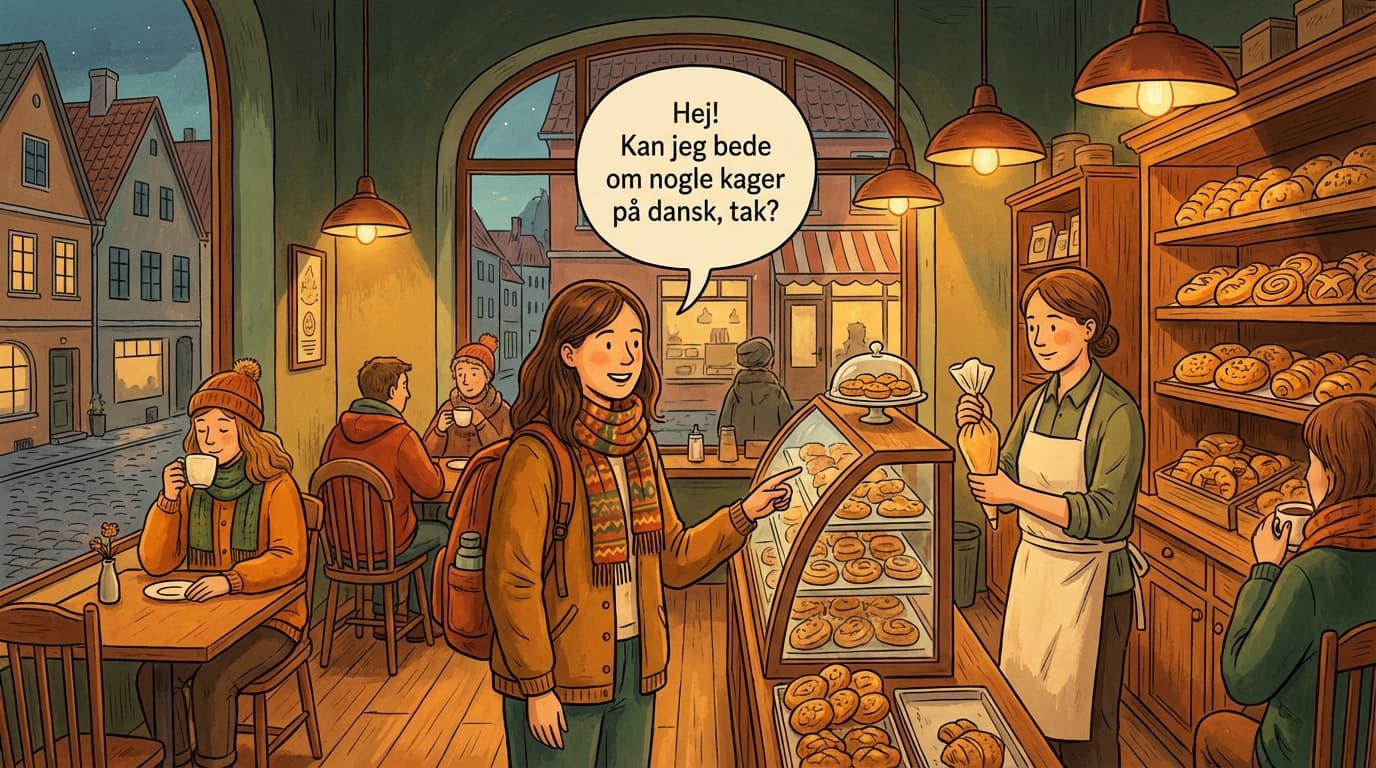
Danish pronunciation is famously tricky — words are compressed, consonants softened, and vowels seem to disappear. But here's the secret: Danes don't expect you to sound perfect. They expect you to try. A heartfelt 'Tak' and 'Hej' will be met with warmth, and the attempt itself becomes a conversation starter. Copenhagen is extremely English-friendly, but smaller Danish towns reward a few local phrases.
Pronunciation Survival Guide
Danish has the same three extra letters as Norwegian: AE (like 'air'), O-slash (like 'ur'), and A-ring (like 'oh'). The stod — a glottal stop that occurs in many Danish words — is what makes Danish sound so distinctive and so difficult. Don't try to master it; just focus on approximating the vowel sounds and let Danes fill in the blanks. D after a vowel is often silent or pronounced like a soft 'th'.
Eating in Copenhagen and Beyond
Danish cuisine has undergone a revolution. New Nordic cuisine, pioneered by Noma, has influenced restaurants throughout the country. But traditional Danish food is equally rewarding: smorrebrod (open sandwiches piled high with herring, roast beef, or shrimp), frikadeller (meatballs), and flaeskesteg (roast pork with crackling). Street food markets like Copenhagen's Reffen offer global options at better prices than sit-down restaurants.
Essential Phrases
| Phrase | English | Pronunciation |
|---|---|---|
| Hej | Hello | hi |
| God morgen | Good morning | go MOR-en |
| Hej hej | Bye bye | hi hi |
| Tak | Thank you | tahk |
| Undskyld | Excuse me / Sorry | oon-SKYUL |
| Ja / Nej | Yes / No | yah / nye |
| Hvor er...? | Where is...? | vor air |
| Hvad koster det? | How much does it cost? | vath KOS-ter deh |
Dining & Restaurant Phrases
| Phrase | English | Pronunciation |
|---|---|---|
| Regningen, tak | The bill, please | RYE-ning-en, tahk |
| Et bord til to | A table for two | et bohr til too |
| Hvad kan du anbefale? | What do you recommend? | vath kan doo AHN-beh-fah-leh |
| Jeg er allergisk over for... | I am allergic to... | yay air ah-LEHR-gisk OH-ver for |
| En ol, tak | A beer, please | en url, tahk |
| Skal! | Cheers! | skoal |
Emergency Phrases
| Phrase | English | Pronunciation |
|---|---|---|
| Hjaelp! | Help! | yelp |
| Jeg har brug for en laege | I need a doctor | yay har broo for en LAY-eh |
| Ring politiet | Call the police | ring poh-lee-TEE-eth |
| Hvor er hospitalet? | Where is the hospital? | vor air hos-pee-TAH-leth |
Cultural Notes
- •Hygge (HOO-guh) is the Danish concept of cozy contentment — candlelit cafes, warm blankets, good company. It's not just a buzzword; it genuinely shapes how Danes live and eat.
- •Denmark is virtually cashless. Even hot dog carts accept cards and MobilePay.
- •Smorrebrod (open-faced sandwiches) are an art form. They're eaten with a knife and fork, never picked up. Eating them in the wrong order (fish first, then meat, then cheese) is traditional.
- •Danes are informal. First names are used almost universally, even in business settings. 'Du' (informal you) is always appropriate.