Pharmacy & Labels · Japan
How to Read Japanese Food Labels: Dates, Allergens & Microwave Wattage
Last updated
From 7-Eleven onigiri to Donki snack hauls, Japanese food packaging is brilliantly structured once you decode 賞味期限 vs 消費期限, Reiwa era years, Japan's updated 2026 allergen rules, and 500W vs 1500W microwave timers.

On this page (12 sections)
- In short
- How it works
- Why Japanese Convenience Store Labels Are Surprisingly Easy Once You Know Four Blocks
- 1. Expiration Dates & Japanese Era Math (賞味期限 vs. 消費期限)
- 2. Japan’s 2026 Mandatory Allergen Labels (特定原材料 / アレルゲン)
- 3. Decoding Konbini Nutrition Boxes (栄養成分表示) & Storage Icons
- 4. Konbini Microwave Wattage Labels (レンジ加熱目安)
- How to Scan Whole Labels in Seconds with Ask Lucy
- Cards to show
- Watch out for
- Common questions
- Use Lucy on the spot
Japanese food labels decoded in 30 seconds
Dates always read Year.Month.Day (26.12.04 = Dec 4, 2026; for Reiwa era stamps like R8, add 2018 → 2026). 消費期限 is a strict safety use-by deadline on fresh food; 賞味期限 is a best-before flavor date on shelf-stable snacks. Under Japan's April 2026 rules, packaged food mandates 9 allergens (adding cashew to the classic 8, with packaging phasing in through March 2028) — snap the full 原材料名 back panel with Ask Lucy to catch hidden dashi, alcohol, or nut traces.
- Date format
- YYYY.MM.DD (or R8 = 2026: add 2018 to the Reiwa number)
- Use-by vs Best-before
- 消費期限 = safety deadline (fresh); 賞味期限 = peak flavor (snacks)
- Mandatory allergens (2026)
- 9 items: wheat, egg, milk, peanut, buckwheat, shrimp, crab, walnut, cashew (phasing in through Mar 2028)
- Konbini microwave math
- 500W = hotel/home microwave; 1500W = commercial 7-Eleven/Lawson counter unit
How it actually works on the spot
-
Check which expiration word sits next to the date
Spot 消費期限 (shōhi kigen) on bento boxes, onigiri, sushi, and cream pastries — eat it before that exact date and hour. Spot 賞味期限 (shōmi kigen) on chips, cookies, and bottled drinks — that is simply a best-quality date.
-
Convert YY.MM.DD or Reiwa (R) years in two seconds
Japan never puts month before day. Read left to right: Year, Month, Day. If a label prints 令和8年 or R8 instead of 2026, just add 2018 (R8 = 2026, R9 = 2027, R10 = 2028).
-
Scan the full 原材料名 ingredient block, not just the icon box
Allergen icon grids cover Japan's mandatory allergens (and often some of the 20 recommended ones), yet bonito fish broth (かつおだし), bivalves, alcohol (酒精), and meat extracts live inside the dense 原材料名 paragraph. Shoot up to 4 photos of the package in Ask Lucy to check every line.
-
Match your microwave wattage before pressing start
Konbini meals print two heating times: a slow 500W time for hotel/home microwaves (e.g., 2 minutes) and a blistering 1500W time (e.g., 40 seconds) for the store's commercial oven behind the cashier. Never run a 500W meal for 30 seconds at your hotel and wonder why the center is frozen.
Why Japanese Convenience Store Labels Are Surprisingly Easy Once You Know Four Blocks
Every 7-Eleven, Lawson, FamilyMart, and neighborhood supermarket in Japan packs astonishingly good food behind a wall of crisp Japanese kanji. The good news: Japanese labeling law puts the exact same four blocks on almost every wrapper — expiration date, ingredients & allergens, nutrition, and storage/heating. Learn those four blocks once and you can shop late-night konbini runs and regional souvenir aisles without accidentally microwaving a cold noodle salad or eating peanut tofu.
1. Expiration Dates & Japanese Era Math (賞味期限 vs. 消費期限)
Japan always writes dates Year → Month → Day (YYYY.MM.DD or YY.MM.DD). So 26.12.04 is December 4, 2026 — never April 12.
Most packaged goods now use Western years, though traditional pickles, tofu, sake, and local bakery packs still stamp the Japanese imperial era Reiwa (令和 / R). The shortcut takes two seconds: add 2018 to the Reiwa number (R8 = 2026, R9 = 2027, R10 = 2028).
Just as important is which of the two expiry kanji sits beside the date:
| Label kanji | Reading | Meaning | Where you will see it |
|---|---|---|---|
| 消費期限 | shōhi kigen | Use-by / safety deadline — do not eat past this stamp | Fresh onigiri, bento boxes, sandwiches, sushi, cream desserts (often lists an exact hour: 午前 = AM, 午後 = PM, or 24-hour 19時) |
| 賞味期限 | shōmi kigen | Best-before / peak flavor — safe shortly after if sealed | Chips, KitKats, cup noodles, cookies, bottled green tea, sauces |
| 製造年月日 | seizō nengappi | Date of manufacture — not an expiration date | Sake, fresh tofu, artisanal breads, some traditional sweets |
2. Japan’s 2026 Mandatory Allergen Labels (特定原材料 / アレルゲン)
Flip any Japanese snack over and look for 原材料名 (genzairyōmei, Ingredients) and the アレルゲン (Allergen) summary box. Under Japan’s Consumer Affairs Agency (CAA) standard, mandatory labeling expanded from the familiar 8 items to 9 mandatory allergens on April 1, 2026 by promoting cashew nuts — with a manufacturer packaging grace period running through March 31, 2028 (meaning shelves in 2026–2027 carry both 8-item and updated 9-item boxes):
| Mandatory allergen | Japanese on label | Reading | Quick note |
|---|---|---|---|
| Wheat | 小麦 | komugi | Hides in regular soy sauce (shoyu), curry roux, tempura |
| Egg | 卵 | tamago | Japanese mayo (very common in onigiri & sandwiches), ramen |
| Milk | 乳 / 乳成分 | nyū / nyūseibun | Milk bread (shokupan), matcha drinks, snack seasonings |
| Peanut | 落花生 / ピーナッツ | rakkasei / pīnattsu | Okinawan jimami tofu, tantanmen, certain dressings |
| Buckwheat | そば | soba | Soba noodles, soba tea (sobacha), shared noodle cookers |
| Shrimp | えび | ebi | Rice crackers, fried snacks, okonomiyaki batter |
| Crab | かに | kani | Seafood mixes, crab-flavored snacks & soups |
| Walnut | くるみ | kurumi | Bakery loaves, granola, walnut soba sauces |
| Cashew (new Apr 2026) | カシューナッツ | kashū nattsu | Mandatory transition runs through March 31, 2028 — read full text too! |
Another 20 recommended allergens — including soy (大豆), sesame (ごま), almond (アーモンド), macadamia (マカダミアナッツ), pistachio (ピスタチオ), pork (豚肉), beef (牛肉), chicken (鶏肉), salmon, mackerel, and gelatin (ゼラチン) — appear on most big-brand konbini wrappers, though they are legally voluntary. Crucially, bonito fish stock (かつおだし) and clams/oysters are NOT on either allergen list, and alcohol (酒精 / 洋酒 / みりん) hides in many soft cakes and sauces — always scan the full 原材料名 paragraph if you follow halal, vegan, vegetarian, pregnancy, or fish-allergy rules.
3. Decoding Konbini Nutrition Boxes (栄養成分表示) & Storage Icons
That crisp little nutrition box on the back of every bento and drink uses five standard rows:
熱量orエネルギー: Calories (kcal) — check whether the header says1包装当たり(per whole package) or100g当たり(per 100 grams).たんぱく質: Protein (g).脂質: Fat (g).炭水化物: Total carbohydrates (g) — sometimes split into糖質(net carbs/sugars) and食物繊維(dietary fiber).食塩相当量: Salt equivalent in grams — not milligrams of sodium! A ramen cup showing5.4gof salt packs roughly 2,100 mg of sodium.- Storage tags:
要冷蔵(10℃以下)= keep refrigerated (≤10°C) ·要冷凍= keep frozen ·直射日光を避け常温= store at room temperature away from sunlight.
4. Konbini Microwave Wattage Labels (レンジ加熱目安)
Look on the front corner of any chilled bento, pasta, or curry tray for the tiny microwave box:
500W 2分30秒(ni-fun sanjū-byō): 2 minutes 30 seconds in a normal 500W hotel-room or home microwave (分= minutes,秒= seconds).1500W 50秒: 50 seconds in the super-powered 1500W commercial oven behind the 7-Eleven, Lawson, or FamilyMart cashier.温めますか?(Atatamemasu ka?): The cashier asking if you want it heated right there! Say “Hai, onegaishimasu” (Yes, please) or “Sono mama de” (As-is, unheated).フタを少し開けて/レンジ不可: Peel one corner of the lid open to vent steam before nuking — and if you seeレンジ不可, do not microwave the tray (usually cold noodles or raw sashimi).
How to Scan Whole Labels in Seconds with Ask Lucy
Squinting at six-point 原材料名 kanji while blocking the 7-Eleven bento aisle gets old fast. Open Ask Lucy on your iPhone (right from the Lock Screen widget) and shoot up to 4 photos in one turn — front, full ingredient list, nutrition box, and date/heating corner.
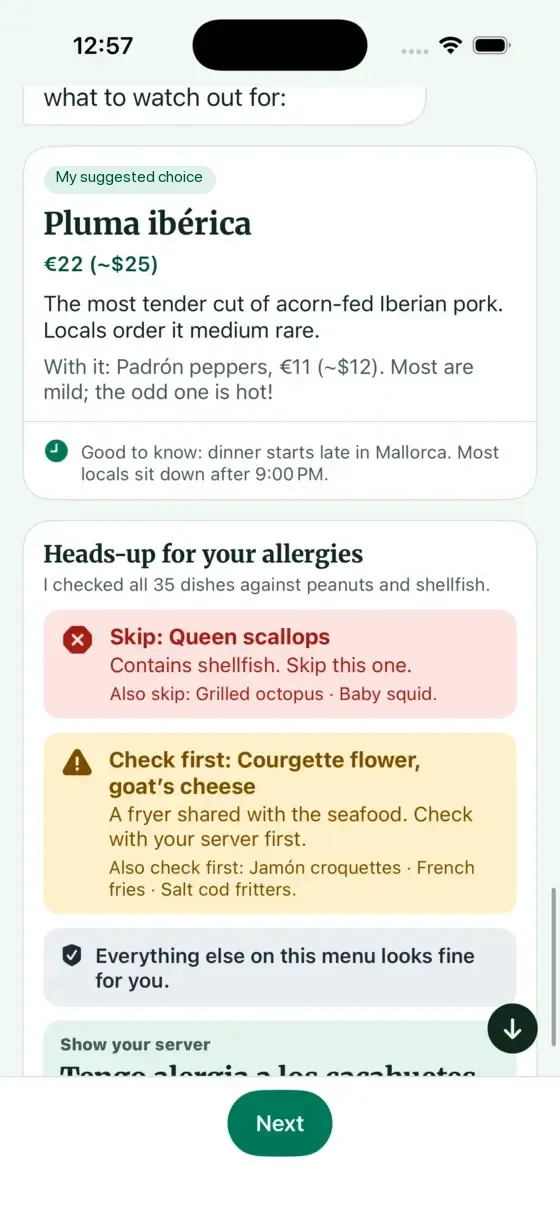
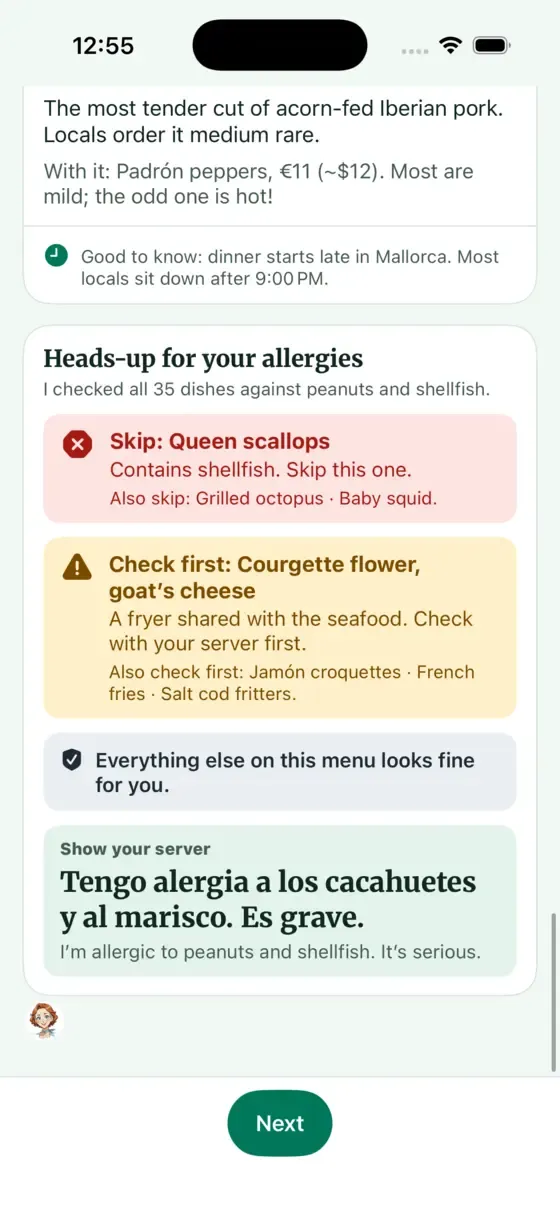
If you saved allergies (with mild, moderate, or severe severity) in your Profile behind explicit Health consent, Lucy evaluates the full ingredient text and returns a four-state Safety verdict (Safe, Caution, Unsafe, or Unknown — never guessing Safe if text is cut off or unclear). Diet (vegan, vegetarian, pescatarian, gluten-free — not Health data) and Pregnancy (Health data) tailor Lucy’s written reply automatically so bonito dashi, pork gelatin, or 酒精 alcohol never slip past you. Remember Ask Lucy requires mobile data or Wi-Fi to generate answers (photos snapped in subterranean grocery basements queue in her Offline outbox until signal returns), so keep an offline Japanese pack in Apple Translate or Google Translate handy as a no-signal backup.
Cards to say or show
Tap any card to show it full screen to a convenience store cashier or supermarket clerk.
Watch out for
- Never confuse 消費期限 with 賞味期限: fresh convenience-store rice balls and cream sandwiches carry 消費期限 down to the exact hour (e.g., 午前3時 = 3 AM) and are genuinely perishable — toss them if past the stamp.
- Salt is labeled in grams of salt, not milligrams of sodium: Japanese nutrition boxes print 食塩相当量 (salt equivalent). Multiply grams of salt by ~400 to estimate milligrams of sodium (2.5 g salt ≈ 1,000 mg sodium).
- Watch the cashew transition through March 2028: Japan's Consumer Affairs Agency expanded mandatory allergens from 8 to 9 by adding cashew nuts (カシューナッツ) on April 1, 2026, but older packaging can remain on shelves through March 31, 2028.
- Hidden alcohol and meat extracts sneak into plain snacks: look for 酒精 (alcohol preservative in soft cakes/noodles), 洋酒 (liquor in chocolates), ゼラチン (gelatin), and チキン・ポークエキス (chicken/pork extract in chips and soup cups).
- Peel the lid corner before microwaving: konbini bentos marked フタを少し開けて (open lid slightly) or レンジ不可 (do NOT microwave — common on raw sushi or cold salads) will steam-pop or melt if heated wrong.
Common questions
What is the difference between 賞味期限 and 消費期限 in Japan?
消費期限 (shōhi kigen) is a strict safety 'use-by' date printed on perishable foods like onigiri, sushi, bento boxes, and fresh sandwiches — do not eat them past that date/time. 賞味期限 (shōmi kigen) is a 'best-before' quality date on shelf-stable snacks, instant ramen, and bottled drinks.
How do I read Japanese Reiwa era dates like R8 on food packages?
Simply add 2018 to the Reiwa number. Reiwa 1 was 2019, so R8 (令和8年) is 2026, R9 is 2027, and R10 is 2028. Dates always appear in Year.Month.Day order — R8.11.25 means November 25, 2026.
How many mandatory food allergens are on Japanese labels?
Japan's Consumer Affairs Agency requires 9 mandatory allergens as of April 1, 2026: wheat, egg, milk, peanut, buckwheat (soba), shrimp, crab, walnut, and cashew (upgraded from the classic 8, with manufacturers given until March 31, 2028 to finish updating packaging). Another 20 allergens — including soy, sesame, almond, macadamia, pistachio, salmon, mackerel, pork, beef, and chicken — are recommended.
Why do Japanese convenience store meals list 500W and 1500W times?
500W (and sometimes 600W) matches standard home and hotel-room microwaves. 1500W matches the high-powered commercial microwaves sitting behind the 7-Eleven, Lawson, or FamilyMart checkout counter, which heat a bento in roughly one-third the time.