Allergies & Diets · South Korea
Vegan Travel Guide to South Korea: Kimchi Traps, Temple Food & Hangul Cards
Last updated
Korean tables overflow with vibrant vegetable banchan and bubbling tofu stews — yet fermented shrimp paste (saeujeot) and anchovy stock (myeolchi yuksu) hide inside dishes that look 100% plant-based. Here is how to eat vegan across Seoul and Busan using Buddhist temple cuisine, smart swaps, and crystal-clear Hangul cards.

On this page (11 sections)
- In short
- How it works
- Why Eating Vegan in South Korea Rewards Knowing One Cultural Twist
- The Hidden Non-Vegan Ingredient Table (Hangul to Spot on Menus & Labels)
- Sachal Eumsik (Buddhist Temple Food) & Everyday Korean Vegan Wins
- Why Positive Hangul Phrasing Saves You From the Korean Yes/No Trap
- How to Configure Ask Lucy for Vegan Travel in South Korea
- Cards to show
- Watch out for
- Common questions
- Use Lucy on the spot
How to eat vegan in South Korea without hidden seafood traps
Never assume vegetable-looking Korean food is vegan: classic kimchi almost always contains salted fermented shrimp (saeujeot) and anchovy fish sauce (aekjeot), and tofu or vegetable stews (doenjang/sundubu jjigae) and tteokbokki normally simmer in anchovy-kelp stock (myeolchi yuksu). Seek out 1,700-year-old Korean Buddhist temple cuisine (sachal eumsik), Seoul's thriving dedicated vegan scene in Insadong, Itaewon, and Hongdae, and always phrase Hangul questions positively (never negative questions!) to avoid Korean Yes/No confusion.
- Hidden trap in kimchi
- Saeujeot (새우젓, salted fermented shrimp) & aekjeot (액젓, anchovy/sand-lance fish sauce)
- Hidden trap in stews & tteokbokki
- Myeolchi yuksu (멸치육수, anchovy broth), clam/beef stock, and fish-cake broth
- Plant-based Korean gem
- Sachal eumsik (사찰음식) — Korean Buddhist temple food (overwhelmingly plant-based, zero meat, fish, seafood, or eggs — confirm no honey/dairy at commercial spots)
- Crucial Hangul rule
- Always ask POSITIVE questions ('Does it contain fish sauce?') — negative Korean questions flip Yes/No!
How it actually works on the spot
-
Learn the four invisible non-vegan ingredients in Korean cooking
Before you touch a single complimentary banchan saucer, memorize the four sneaky bases: saeujeot (salted shrimp), aekjeot (fish sauce), myeolchi yuksu (anchovy stock), and dasida/sagol (beef seasoning or bone broth). Even plain-looking spinach or radish banchan can be dressed with fish sauce.
-
Experience sachal eumsik (Buddhist temple food) and Seoul's vegan hubs
Insadong (around Jogyesa Temple) and Bukchon serve transcendent multi-course temple banquets built on fermented jang pastes, wild mountain greens, and lotus-leaf rice — overwhelmingly plant-based (zero meat, fish, seafood, eggs, or pungent alliums; confirm no honey or dairy at commercial temple-style spots). Pair temple lunches with dedicated vegan BBQ, kalguksu, and bakeries across Itaewon, Hongdae, Yeonnam-dong, and Seongsu.
-
Use strictly POSITIVE phrasing on every Hangul card and question
In Korean, answering a negative question like 'Doesn't this have fish sauce?' produces inverted Yes/No replies ('Yes, it doesn't!'). Always ask directly 'Does this contain meat, seafood, anchovy stock, or fish sauce?' so 네 (Yes) means it contains it and 아니요 (No) means it does not.
-
Scan convenience-store wrappers and Hangul wall menus before ordering
CU, GS25, and 7-Eleven Korea carry growing vegan-labeled snacks alongside traps hiding pork extract, oyster sauce, or egg mayo. Snap up to 4 photos of wall boards or full back-of-pack Hangul ingredient lists with Ask Lucy to spot hidden seafood and animal seasonings before you buy.
Why Eating Vegan in South Korea Rewards Knowing One Cultural Twist
South Korea sits in a fascinating spot for plant-based travelers. On one hand, it owns one of the world’s oldest, most sophisticated overwhelmingly plant-based culinary traditions — Korean Buddhist temple food (sachal eumsik) (zero meat, fish, seafood, eggs, or pungent alliums — confirm no honey or dairy at commercial temple-style spots) — alongside an exploding wave of hip vegan bakeries, vegan BBQ houses, and plant-based noodle bars across Seoul and Busan.
On the other hand, walking casually into a traditional neighborhood stew shop (see our Ordering Food in Korea Guide for table bells, drawers, and etiquette) without checking the invisible broths will trip up almost every first-timer. Even dishes framed around vegetables and tofu rely on deeply savory seafood bases that vanish completely into the soup.
The Hidden Non-Vegan Ingredient Table (Hangul to Spot on Menus & Labels)
Screenshot this cheat sheet for restaurant checks and convenience-store 원재료명 (Ingredients) panels at CU, GS25, and 7-Eleven Korea:
| Hangul to spot | Reading | What it actually is | Where it hides |
|---|---|---|---|
| 새우젓 | saeujeot | Salted fermented tiny shrimp | Almost all standard kimchi, pork/tofu stews, dipping sauces |
| 액젓 / 멸치액젓 / 까나리액젓 | aekjeot | Fermented anchovy or sand-lance fish sauce | Kimchi, seasoned vegetable banchan, salad dressings, soups |
| 멸치육수 / 다시마멸치육수 | myeolchi yuksu | Anchovy-kelp stock | Doenjang jjigae (soybean stew), sundubu jjigae (soft tofu stew), kalguksu noodles, tteokbokki |
| 굴소스 | gul soseu | Oyster sauce | Japchae glass noodles, stir-fried vegetables, fried rice |
| 사골육수 / 소고기 다시다 | sagol yuksu / dasida | Beef bone broth / beef bouillon seasoning | Naengmyeon cold noodles, rice cake soup (tteokguk), seasoned bibimbap greens |
| 어묵 / 맛살 | eomuk / matsal | Fish cake / imitation crab | Street tteokbokki broth, classic gimbap rolls, udon bowls |
| 계란 / 난류 / 우유 / 버터 | gyeran / nallyu / uyu / beoteo | Egg / milk / butter | Bibimbap toppings, jeon savory pancake batters, bakery breads, creamy juk porridges |
| 채식 / 비건 / 사찰 | chaesik / bigeon / sachal | Vegetarian / Vegan / Temple-style | Green-light keywords to spot on menus, cafés, and packaged seals! |
Sachal Eumsik (Buddhist Temple Food) & Everyday Korean Vegan Wins
If you only splurge on one meal in Seoul, make it sachal eumsik (사찰음식, Korean Buddhist temple cuisine) around Insadong or Bukchon. Shaped over centuries by Seon (Zen) monastic kitchens, temple food is overwhelmingly plant-based — zero meat, fish, seafood, or eggs (confirm no honey or dairy at commercial temple-style spots) — and traditionally also avoids the five pungent roots (osinchae: garlic, scallions, leeks, chives, and wild rocambole) so the clean flavors of fermented doenjang, roasted sesame, perilla oil (deulgireum), lotus root, pine nuts, and wild mountain greens (namul) shine on their own.
Beyond temple feasts and dedicated vegan spots in Itaewon/Haebangchon, Hongdae/Yeonnam-dong, Insadong, and Seongsu-dong, keep these everyday Korean dishes on your radar (always confirming preparation with your Hangul card!):
- Kongguksu (
콩국수, summer): Silky, nutty chilled soy-milk broth poured over wheat noodles with crisp cucumber — naturally vegan (just ask to leave off the half boiled egg!). - Yachae bibimbap (
야채비빔밥— customized): Steamed rice topped with seasonal greens and sweet-spicy gochujang paste; ask clearly for no meat, no egg, and no beef seasoning (dasida). - Hobakjuk (
호박죽) & Patjuk (팥죽): Velvety sweet pumpkin porridge and warm red-bean porridge with chewy rice cakes — traditionally plant-based (confirm no milk or butter at modern chains). - Yachae gimbap (
야채김밥— customized): Seaweed rice rolls usually sneak in ham (햄), imitation crab (맛살), and egg strip (계란) — at neighborhood gimbap counters that roll fresh to order, ask for cucumber, carrot, pickled radish (단무지), burdock (우엉), and perilla leaf only. - Traditional tea houses & tteok rice cakes: Insadong tea houses serve jujube tea (daechucha), ginger tea (saenggangcha), and chewy steamed rice cakes (injeolmi, songpyeon, yakgwa — check yakgwa for honey!).
Why Positive Hangul Phrasing Saves You From the Korean Yes/No Trap
One tiny grammar rule makes a huge difference in Korea: never ask an ingredient question in the negative.
In English, if you ask “Doesn’t this have fish sauce?” and the dish is fish-free, you say “No (it doesn’t).” In Korean, answering a negative question confirms or denies the entire negative clause: a helpful server says “네” (Ne, “Yes — you are correct, it does NOT have fish sauce!”), which terrified travelers immediately translate as “Yes, it has fish sauce!”
Stick strictly to direct positive questions — “이 음식에 액젓이 들어가나요?” (“Does this dish contain fish sauce?”) — where “네” always means “Yes, it contains it” and “아니요” always means “No, it does not.” Every card above is written this way for you.
How to Configure Ask Lucy for Vegan Travel in South Korea
Before landing at Incheon, set up your Ask Lucy Profile on iPhone or iPad (iOS 26+):
- Select
veganunder Diet (not Health data — no Health consent required). - Add Korean specifics in Notes to Lucy (up to 2,000 characters, read with every turn): “Strict vegan in South Korea — flag saeujeot shrimp paste, aekjeot fish sauce, myeolchi anchovy broth, oyster sauce, dasida beef powder, egg batter, and dairy. Write Hangul Show-your-server cards using direct positive phrasing only.”
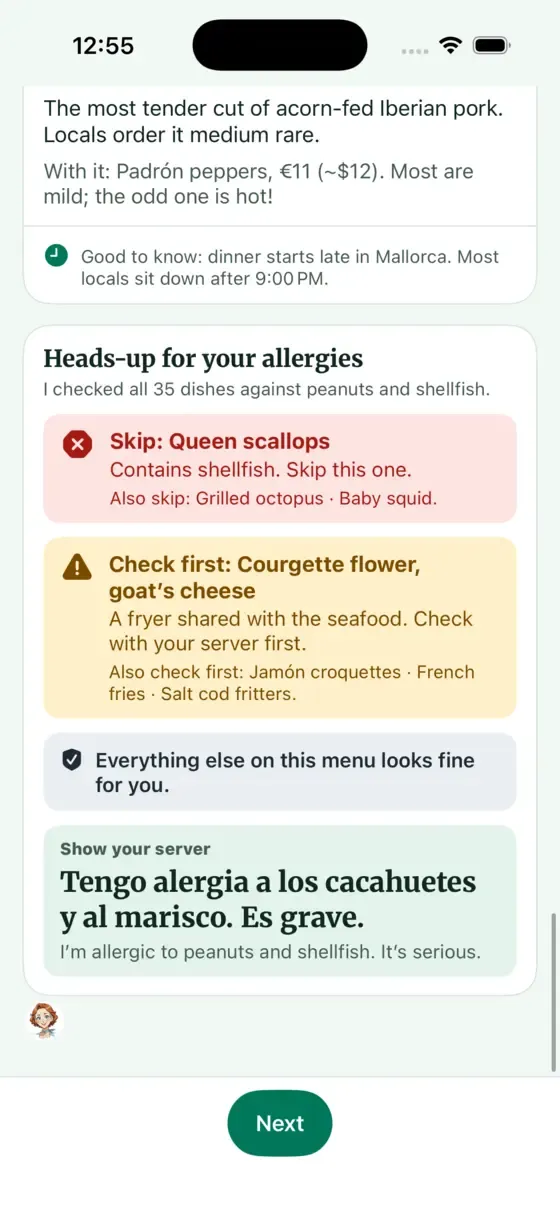
Remember the clean distinction in Ask Lucy: Diet and Notes to Lucy shape Lucy’s written replies, menu explanations, and Hangul Show-your-server cards — they do not generate four-state Safety verdict cards. Safety verdicts (Safe, Caution, Unsafe, Unknown) run exclusively for medical allergies saved behind explicit Health consent (so if you also have a shellfish, buckwheat, or dairy allergy, add it as an allergy with its Severity too).
When staring at a Hangul-only market board or a tiny CU/GS25 ingredient back panel, shoot up to 4 photos in one turn. Lucy breaks down every line, translates won into Home-first prices ($9.50 (₩13,000)), and drafts a clear positive-phrased Hangul Show-your-server card on screen. Since Ask Lucy requires Wi-Fi or mobile data to generate answers (subway-arcade snaps queue in her Offline outbox until signal returns), keep an offline Korean pack in Apple Translate or Google Translate as your dead-zone backup, and switch to their Conversation mode whenever you need a live spoken back-and-forth.
Cards to say or show
Tap any Hangul card to display it full screen. Every card uses clear positive statements and direct positive questions so you never hit Korean Yes/No inversion.
Watch out for
- Never ask negative questions in Korean ('Doesn't this have shrimp?'): in Korean grammar, 네 ('Yes') confirms your negative wording ('Yes, it does NOT have shrimp'), creating dangerous misunderstandings — always ask positively ('Does this contain shrimp?').
- Assume all standard kimchi contains seafood: unless labeled vegan kimchi (비건 김치) or served at a Buddhist temple restaurant, Korean kimchi almost universally uses salted fermented shrimp (새우젓) and anchovy or sand-lance fish sauce (액젓).
- Soft tofu stew (sundubu jjigae) and street tteokbokki are rarely vegan: sundubu normally uses clam, pork, or anchovy broth plus a cracked raw egg; street tteokbokki simmers in anchovy stock beside boiling fish cakes (어묵).
- Watch hidden oyster sauce (굴소스) and beef powder (다시다): stir-fried noodles (japchae), seasoned bibimbap vegetables, and vegetable pancakes (yachaejeon) frequently include oyster sauce, beef seasoning, or egg batter.
- Convenience-store labels do not separate anchovy from 'vegetable' flavors: scan the full 원재료명 (Ingredients) box on CU, GS25, and 7-Eleven packs for 멸치 (anchovy), 새우 (shrimp), 조개 (clam), 돼지고기 (pork), 소고기 (beef), 우유 (milk), and 계란 (egg).
Common questions
Is Korean kimchi vegan?
Classic Korean kimchi is almost never vegan. Traditional recipes rely on saeujeot (salted fermented tiny shrimp) and myeolchi/kkanari aekjeot (anchovy or sand-lance fish sauce) for deep savory fermentation, and winter batches sometimes add raw oysters. Look specifically for vegan kimchi (비건 김치) at vegan restaurants, specialty stores, or Buddhist temple kitchens (사찰 김치).
Why should I never ask negative questions about ingredients in Korean?
Korean answers agree with the truth of the entire sentence rather than the English logic of the ingredient. If you ask 'Isn't there fish sauce in this?' and the dish has NO fish sauce, a Korean server politely answers '네' ('Yes' — meaning 'Yes, you are right, there isn't!'), which English speakers often mishear as 'Yes, there is fish sauce.' Always ask a direct positive question ('Does this contain fish sauce?') so 네 means yes-it-does and 아니요 means no-it-does-not.
What traditional Korean dishes are easiest to find naturally vegan?
Korean Buddhist temple cuisine (사찰음식) is overwhelmingly plant-based (zero meat, fish, seafood, eggs, or pungent alliums — confirm no honey or dairy at commercial temple-style spots). Outside temple kitchens, look for summer kongguksu (chilled creamy soybean noodle soup — just ask to skip the boiled egg garnish), hobakjuk (sweet pumpkin porridge) and patjuk (red bean porridge — confirm no milk/butter), plain steamed rice with sesame-dressed namul greens (verify no fish sauce), and dedicated vegan versions of bibimbap, gimbap, and jjajangmyeon.
Does setting Diet to vegan in Ask Lucy trigger Safety verdict cards?
No. In Ask Lucy, Diet (vegetarian, vegan, pescatarian, or gluten free) and Notes to Lucy shape Lucy's written replies, dish guidance, and Hangul Show-your-server cards without requiring Health consent — they do not produce Safety verdict cards. Four-state Safety verdicts (Safe, Caution, Unsafe, Unknown) are exclusively for medical allergies saved behind one-tap Health consent.
Where are the best neighborhoods in Seoul for vegan food?
Insadong (especially around Jogyesa Temple) is the heart of Buddhist temple dining and traditional vegan restaurants. Itaewon and Haebangchon offer international and modern Korean vegan eateries, Hongdae and Yeonnam-dong pack vegan cafés, bakeries, and fusion spots, and Seongsu-dong has become a creative hub for plant-based bakeries and dining.