
Vietnam
Essential Vietnamese Phrases for Travelers
Last updated March 29, 2026
Vietnamese uses the Latin alphabet (with many diacritical marks indicating tones), making it visually more approachable than Chinese or Thai. However, it has six tones and pronunciation can be quite challenging for English speakers. The good news: Vietnamese people are exceptionally warm to visitors who try, and even basic attempts at greetings and food vocabulary will enhance your experience dramatically.
Why Learn Vietnamese Phrases for Travel?
Vietnam is a country where food, culture, and language are deeply intertwined. Knowing how to order 'Pho bo' (beef pho), ask for 'Khong cay' (not spicy), or exclaim 'Ngon qua!' (delicious!) transforms meals from transactions into connections. English is growing among younger Vietnamese, but in markets, street food stalls, and smaller towns, Vietnamese phrases are often essential.
Vietnamese Tones and Script
Vietnamese uses the Latin alphabet with extensive diacritical marks that indicate tone and vowel quality. There are six tones: level (no mark), rising, falling, broken/creaky, questioning/dipping, and heavy/falling-glottal. Northern (Hanoi) and Southern (Ho Chi Minh City) Vietnamese pronunciation differ significantly — like comparing Scottish and Australian English. Don't worry about tones when starting out; context usually conveys your meaning.
Vietnamese Food: The World's Best Street Cuisine
Vietnamese cuisine is one of the world's healthiest and most flavourful food traditions. Pho (noodle soup) is the national dish — eaten for breakfast, lunch, and dinner. Banh mi (baguette sandwiches with pate, vegetables, and herbs) are a French-Vietnamese fusion masterpiece. Bun cha (grilled pork with noodles), goi cuon (fresh spring rolls), and com tam (broken rice plates) are essential. Everything is fresh, light, and intensely flavourful. Street food is safe at high-turnover stalls and costs 30,000-60,000 VND (1-2.50 euros).
Essential Phrases
| Phrase | English | Pronunciation |
|---|---|---|
| Xin chao | Hello | sin CHOW |
| Tam biet | Goodbye | tahm bee-ET |
| Cam on | Thank you | gahm UHN |
| Xin loi | Sorry / Excuse me | sin LOY |
| Vang / Khong | Yes / No | vuhng / kohm |
| ...o dau? | Where is...? | uh DOW |
| Bao nhieu tien? | How much money? | bow nyew tee-EN |
| Dat qua | Too expensive | daht kwah |
| Toi khong hieu | I don't understand | toy kohm hee-OO |
Dining & Restaurant Phrases
| Phrase | English | Pronunciation |
|---|---|---|
| Tinh tien | The bill, please | tin tee-EN |
| Ngon qua! | Delicious! | ngon KWAH |
| Khong cay | Not spicy | kohm KAI |
| Mot bia, xin | One beer, please | moht BEE-ah, sin |
| Cho toi xem thuc don | Let me see the menu | choh toy sem tuhk duhn |
| Pho bo / Pho ga | Beef pho / Chicken pho | fuh baw / fuh gah |
Emergency Phrases
| Phrase | English | Pronunciation |
|---|---|---|
| Cuu toi! | Help me! | KOO-oo toy |
| Toi can bac si | I need a doctor | toy kuhn bahk SEE |
| Goi canh sat | Call the police | goy KANH saht |
| Benh vien o dau? | Where is the hospital? | baynh vee-EN uh DOW |
Cultural Notes
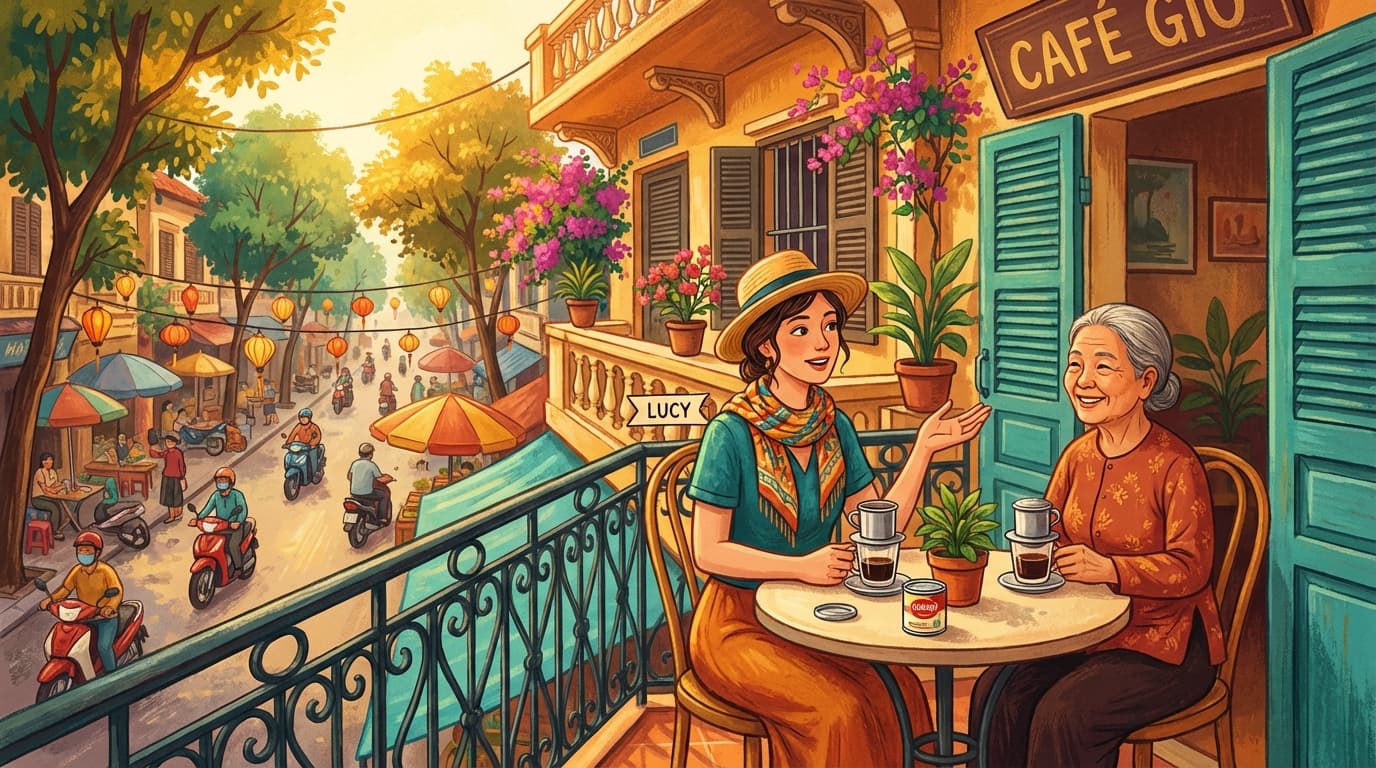
- •Vietnamese coffee is strong, sweet, and life-changing. Ca phe sua da (iced coffee with condensed milk) is the national drink. It drips slowly through a metal filter — patience is required and rewarded.
- •Crossing the street in Vietnam looks impossible — traffic doesn't stop. The secret: walk slowly and steadily at a constant pace. Motorbikes will flow around you. Never stop suddenly or run.
- •Bargaining is expected at markets but not at restaurants or shops with fixed prices. Start at about 50% and negotiate cheerfully.
- •Vietnamese culture values modesty and respect for elders. The word for 'I' and 'you' changes depending on the age and relationship of the speakers — for travelers, 'toi' (I) is safe in all contexts.