
Malaysia, Brunei, Singapore
Essential Malay Phrases for Travelers
Last updated March 29, 2026
Malay (Bahasa Melayu) is closely related to Indonesian — speakers of either language can understand each other with minor adjustments. For travellers in Malaysia, basic Malay phrases are easy to learn and deeply appreciated, especially in Malay-majority areas and local food stalls. Malaysia's multicultural society (Malay, Chinese, Indian) means English is widely spoken, but Malay phrases show respect for the national culture.
Why Learn Malay Phrases for Travel?
Malaysia is one of Southeast Asia's most multicultural countries, and while English is widely spoken (especially in cities), Malay phrases connect you to the dominant culture in a way English doesn't. At a mamak stall (Indian-Muslim restaurant) at midnight, ordering 'roti canai dan teh tarik' in Malay gets a smile and often better service than pointing at a menu. In kampungs (villages) and rural areas, Malay may be the only shared language.
Malay vs Indonesian
Malay and Indonesian are mutually intelligible — about 80% shared vocabulary. Key differences: 'hospital' vs 'rumah sakit' (hospital), 'kereta' vs 'mobil' (car), 'kedai' vs 'toko' (shop). If you know one, you can navigate the other with minor adjustments. The pronunciation in Malaysia tends to be slightly more clipped than in Indonesia.
Malaysian Food Culture
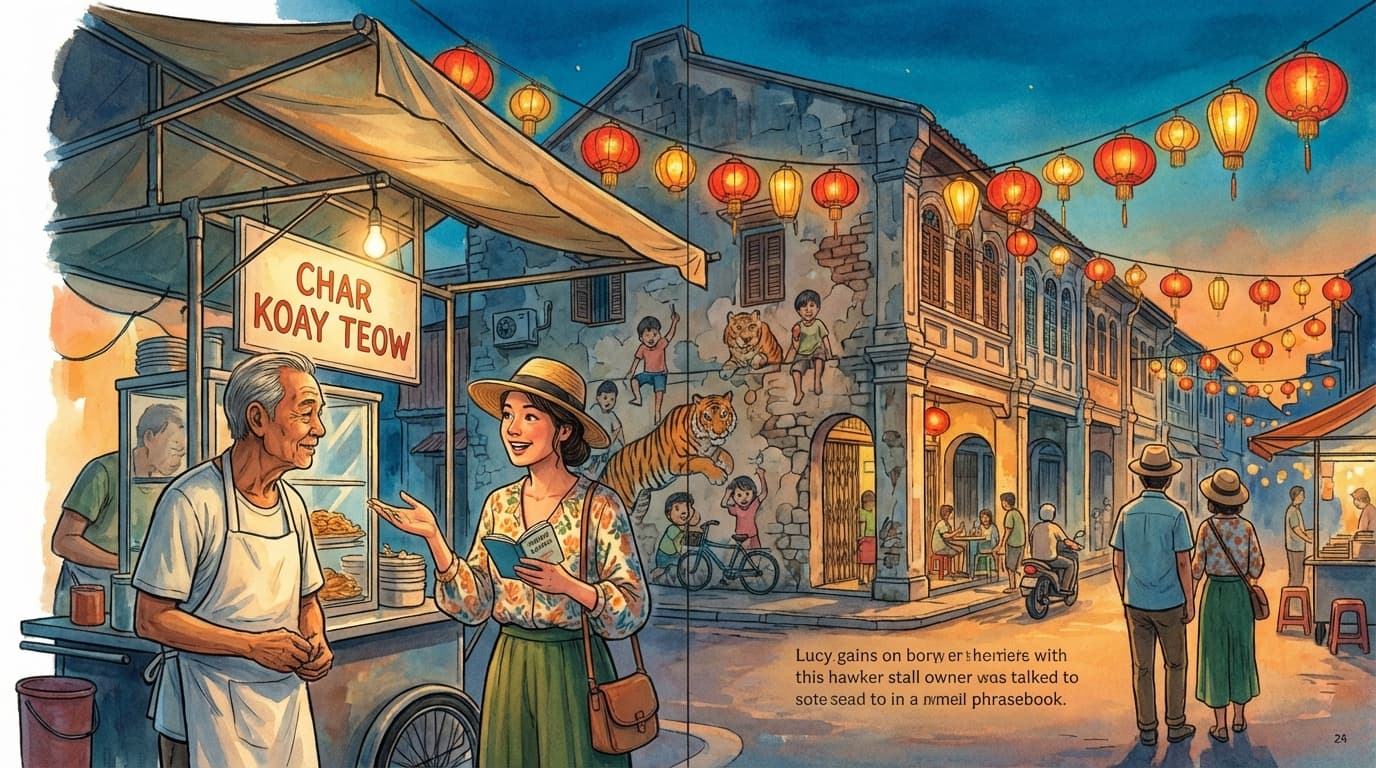
Malaysian food is arguably Southeast Asia's most diverse. Nasi lemak (coconut rice with sambal, anchovies, peanuts, and egg) is the national dish, eaten for breakfast and any other meal. Char kway teow (stir-fried flat noodles), laksa (spicy coconut noodle soup), satay, and roti canai (flaky flatbread with curry dipping sauce) are all essential. Hawker centres are the best places to eat — find a table, order from multiple stalls, and feast. A full meal costs RM8-15 (1.50-3 euros).
Essential Phrases
| Phrase | English | Pronunciation |
|---|---|---|
| Selamat pagi | Good morning | seh-LAH-maht PAH-gee |
| Apa khabar? | How are you? | AH-pah KAH-bar |
| Terima kasih | Thank you | teh-REE-mah KAH-seh |
| Sama-sama | You're welcome | SAH-mah SAH-mah |
| Maafkan saya | Excuse me / I'm sorry | mah-AHF-kahn SAH-yah |
| Di mana...? | Where is...? | dee MAH-nah |
| Berapa harga ini? | How much is this? | beh-RAH-pah HAR-gah EE-nee |
| Saya tak faham | I don't understand | SAH-yah tahk FAH-hahm |
Dining & Restaurant Phrases
| Phrase | English | Pronunciation |
|---|---|---|
| Bil, sila | The bill, please | bil, SEE-lah |
| Sedap sangat! | Very delicious! | seh-DAHP SAHNG-aht |
| Tak pedas | Not spicy | tahk PEH-dahs |
| Saya alah kepada... | I'm allergic to... | SAH-yah AH-lah keh-PAH-dah |
| Teh tarik satu | One pulled tea | teh TAH-rik SAH-too |
| Nasi lemak | Coconut rice (national dish) | NAH-see leh-MAHK |
Emergency Phrases
| Phrase | English | Pronunciation |
|---|---|---|
| Tolong! | Help! | TOH-long |
| Saya perlukan doktor | I need a doctor | SAH-yah per-LOO-kahn DOK-tor |
| Panggil polis | Call the police | PAHNG-geel POH-lis |
| Di mana hospital? | Where is the hospital? | dee MAH-nah HOS-pee-tahl |
Cultural Notes
- •Malaysia is a Muslim-majority country with significant Chinese and Indian minorities. Dress modestly near mosques, and remove shoes before entering places of worship.
- •Teh tarik (pulled tea) — hot tea with condensed milk poured back and forth between cups to create a frothy texture — is Malaysia's signature drink.
- •Malaysian food is a magnificent fusion of Malay, Chinese, and Indian cuisines. Hawker centres (food courts) serve all three traditions under one roof at very reasonable prices.
- •Use your right hand for eating and exchanging items. In Malay culture, the left hand is considered unclean.