
Thailand
Essential Thai Phrases for Travelers
Last updated March 29, 2026
Thai is a tonal language with five tones and its own unique script. While this makes it challenging to master, travel Thai is remarkably effective — a few well-placed phrases, accompanied by the appropriate politeness particle (khrap for men, kha for women), will open doors throughout Thailand. Thai culture places enormous value on politeness and saving face, and your linguistic effort will be rewarded with genuine warmth.
Why Learn Thai Phrases for Travel?
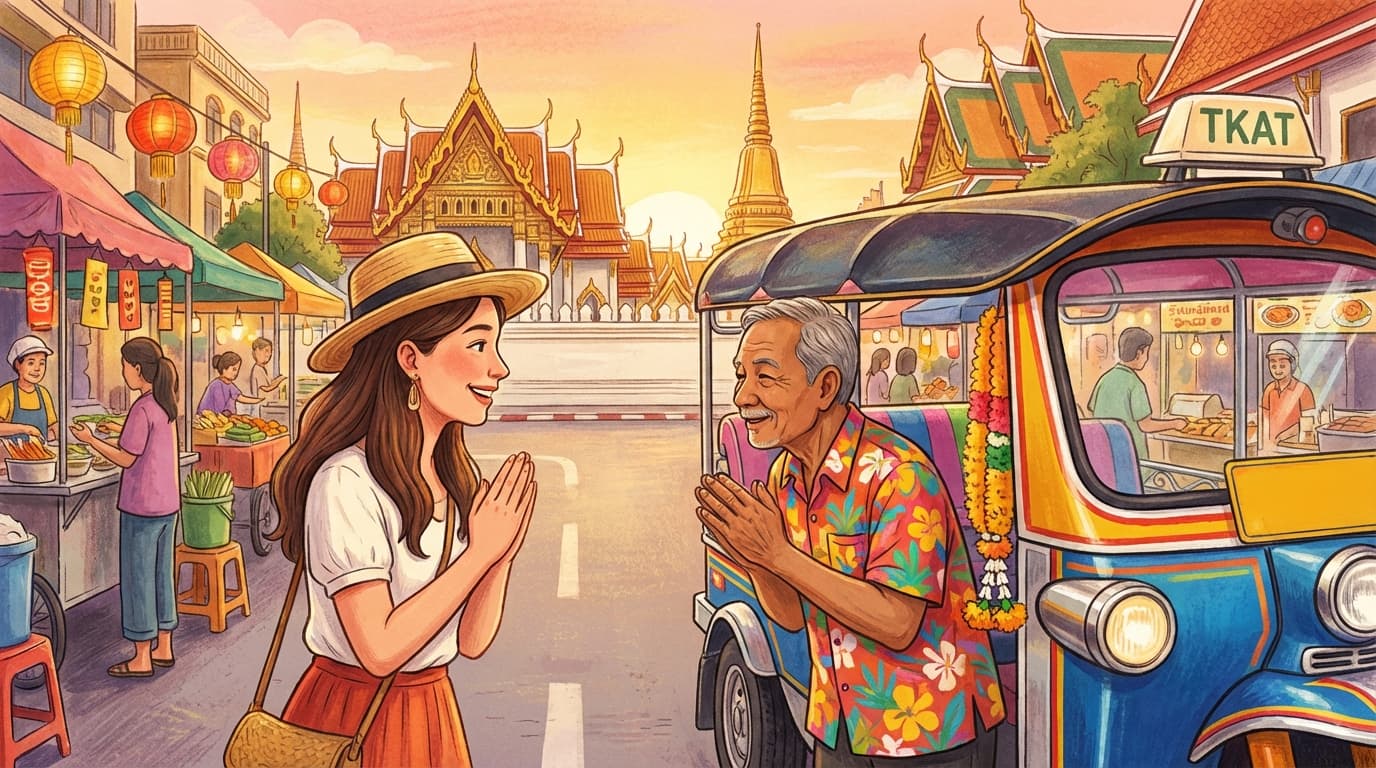
Thailand is one of the world's most popular tourist destinations, and while the tourism infrastructure operates in English, the real Thailand operates in Thai. Markets, street food stalls, tuk-tuk negotiations, and local restaurants all run smoother with a few Thai phrases. More importantly, Thai culture deeply values politeness and effort — a 'Sawasdee khrap/kha' with a wai (prayer-like gesture) communicates respect in a way that English simply cannot.
Thai Tones
Thai has five tones: mid (flat, neutral), low (flat, lower pitch), falling (starts high, drops), high (flat, higher pitch), and rising (starts low, goes up). Getting tones wrong can change meaning — 'mai' with different tones can mean 'new', 'not', 'silk', 'burn', or be a question particle. Don't worry too much: context usually makes your meaning clear, and Thais are accustomed to tonal variation. Focus on learning set phrases rather than individual words.
Street Food and Dining
Thai street food is a UNESCO-recognized cultural treasure. Pad thai from a wok on the street, som tam (green papaya salad) pounded to order, khao pad (fried rice), and mango sticky rice are all best eaten from carts and stalls. When ordering, specify your spice level — 'Mai phet' (not spicy), 'Phet nit noi' (a little spicy), or be brave with 'Phet mak' (very spicy). Thai spicy is significantly hotter than most Western palates expect. A plate of street food costs 40-80 baht (1-2 euros), making Thailand one of the world's best destinations for eating well on a budget.
Essential Phrases
| Phrase | English | Pronunciation |
|---|---|---|
| Sawasdee khrap/kha | Hello / Goodbye | sah-wah-DEE krahp/kah |
| Khop khun khrap/kha | Thank you | kohp-KOON krahp/kah |
| Chai / Mai chai | Yes / No | chy / my chy |
| Kho thot | Sorry / Excuse me | koh-TOHT |
| ...yoo tee nai | Where is...? | yoo tee NYE |
| Thao rai | How much? | tow-RYE |
| Phaeng pai | Too expensive | paeng bye |
| Lot dai mai | Can you reduce the price? | lot dye my |
| Mai khao jai | I don't understand | my cow JY |
Dining & Restaurant Phrases
| Phrase | English | Pronunciation |
|---|---|---|
| Kep ngern | The bill, please | gep NGERN |
| Mai phet | Not spicy | my PET |
| Phet nit noi | A little bit spicy | pet NIT-noy |
| Aroi mak | Very delicious | ah-ROY mahk |
| Nam plao | Plain water | nahm PLAO |
| Bia nueng kuat | One bottle of beer | bee-ah NOONG kwot |
Emergency Phrases
| Phrase | English | Pronunciation |
|---|---|---|
| Chuay duay! | Help! | CHOO-ay DOO-ay |
| Tong kan mor | I need a doctor | tong gahn MOH |
| Riak tam ruat | Call the police | ree-AHK tahm-ROO-at |
| Rong phayaban yoo tee nai | Where is the hospital? | rohng pah-yah-BAHN yoo tee NYE |
Cultural Notes
- •Thai men end polite sentences with 'khrap' and women with 'kha'. Adding this particle to any phrase makes it polite. Without it, you sound abrupt.
- •The Thai Royal Family is deeply revered. Never make disrespectful comments about the monarchy — it's both culturally offensive and illegal (lese-majeste laws carry prison sentences).
- •The wai (pressing palms together at chest level with a slight bow) is the Thai greeting. Return a wai when greeted this way, but don't wai to children or service staff.
- •Feet are considered the lowest and dirtiest part of the body. Never point your feet at a person or a Buddha image. Remove shoes when entering temples and homes.
- •Thai street food is safe, delicious, and incredibly cheap. Look for stalls with high turnover (fresh food) and a crowd of Thai customers.