
Canada (Quebec, New Brunswick, Ontario)
Essential Quebecois French Phrases for Travelers
Last updated March 29, 2026
Quebecois French is a vibrant, distinctive variety of French that has evolved separately from European French for over 400 years. It preserves some archaic French features while incorporating English loanwords and unique Quebecois expressions. For travellers visiting Montreal, Quebec City, and the province of Quebec, a few local phrases show cultural sensitivity — Quebecois are proud of their language and appreciate visitors who make the effort.
Why Learn Quebecois French for Travel?
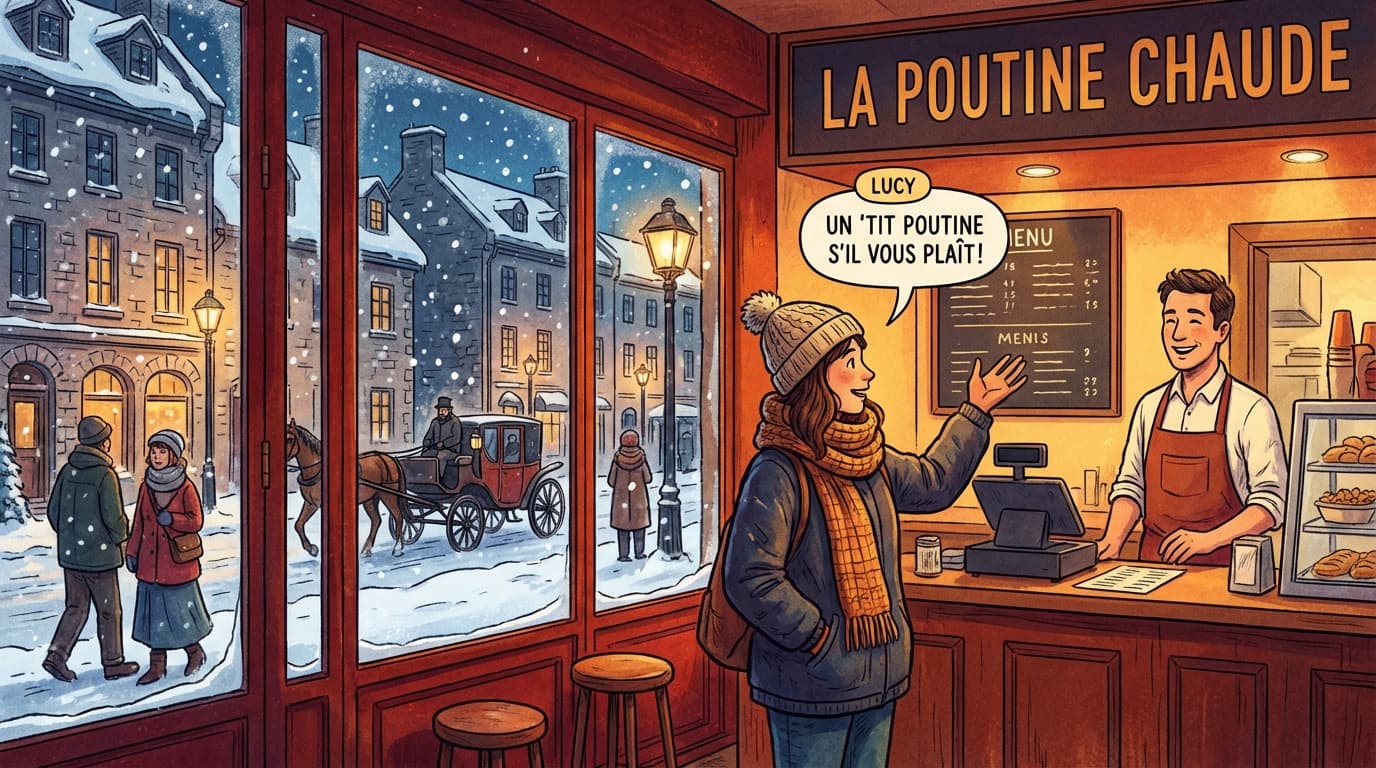
Quebec is a French-speaking society within North America, and language is central to its identity. Bill 101 ensures that French is the dominant public language, and Quebecois are proud of this distinction. Starting conversations in French — even if your French is imperfect — is noticed and appreciated. In Montreal, most people are bilingual, but Quebec City and smaller towns are more uniformly francophone.
Quebecois vs France French
Quebecois French sounds distinctly different from Parisian French. Vowels are more open, certain consonants shift (TU becomes 'tsu', DU becomes 'dzu'), and the accent has a musical quality. Vocabulary differs too: 'car' is 'char' (not 'voiture'), 'fun' is borrowed directly as 'le fun', and many everyday expressions are unique. A France French speaker and a Quebecois speaker can understand each other but will immediately notice the differences, similar to American vs British English.
Quebec Food Culture
Quebec cuisine blends French culinary tradition with North American heartiness. Poutine is the iconic dish, but the food scene goes far deeper: tourtiere (meat pie), cretons (pork spread), smoked meat sandwiches (Montreal's answer to pastrami), sugar pie (tarte au sucre), and maple everything during sugaring-off season. Montreal is one of North America's greatest food cities, with an extraordinary restaurant scene that rivals New York at better prices. In winter, comfort food reigns; in summer, terrasses (patios) fill with diners and good wine.
Essential Phrases
| Phrase | English | Pronunciation |
|---|---|---|
| Bonjour | Hello / Good day | bon-ZHOOR |
| Salut | Hi / Bye (casual) | sah-LOO |
| Merci | Thank you | mair-SEE |
| S'il vous plait | Please | seel voo PLEH |
| Excusez-moi | Excuse me | ek-skew-ZAY mwah |
| Bienvenue | You're welcome (Quebecois usage) | bee-en-veh-NOO |
| Ou est...? | Where is...? | oo EH |
| C'est combien? | How much is it? | say kom-bee-EN |
| C'est correct | It's all good / No problem | say koh-REKT |
| C'est l'fun! | That's fun/great! | say le-FUHN |
Dining & Restaurant Phrases
| Phrase | English | Pronunciation |
|---|---|---|
| L'addition, s'il vous plait | The bill, please | lah-dee-see-ON, seel voo PLEH |
| C'est delicieux! | It's delicious! | say day-lee-see-UH |
| Une poutine | Fries, gravy, and cheese curds | oon poo-TEEN |
| Un pichet de biere | A pitcher of beer | un pee-SHEH duh bee-AIR |
| Je suis allergique a... | I am allergic to... | zhuh swee ah-lehr-ZHEEK ah |
| Une carafe d'eau | A carafe of tap water | oon kah-RAHF DOH |
Emergency Phrases
| Phrase | English | Pronunciation |
|---|---|---|
| Au secours! | Help! | oh suh-KOOR |
| J'ai besoin d'un medecin | I need a doctor | zhay buh-ZWAN dun med-SAN |
| Appelez la police | Call the police | ah-play lah poh-LEES |
| Ou est l'hopital? | Where is the hospital? | oo eh loh-pee-TAHL |
Cultural Notes
- •Language politics are sensitive in Quebec. Always start with 'Bonjour' — beginning in English can be perceived as dismissive of Quebec's French-language identity.
- •'Bienvenue' means 'you're welcome' in Quebec (not just 'welcome' as in France). When someone says 'Merci', Quebecois respond with 'Bienvenue'.
- •Poutine (fries, cheese curds, gravy) originated in Quebec and is the province's most iconic dish. Don't call it 'Canadian poutine' — it's Quebecois.
- •Quebec has its own distinct culture separate from English Canada — its own music, comedy, television, and cuisine. Treating it as a unique cultural experience rather than 'Canada but French' shows awareness.