
Haiti
Essential Haitian Creole Phrases for Travelers
Last updated March 29, 2026
Haitian Creole (Kreyol) is a French-based creole language spoken by virtually all Haitians. While French is the other official language, Creole is what people actually speak daily. For travellers visiting Haiti or Haitian communities in the Caribbean, Kreyol is surprisingly accessible — it has simplified grammar compared to French, phonetic spelling, and a warm, expressive quality that reflects Haitian culture.
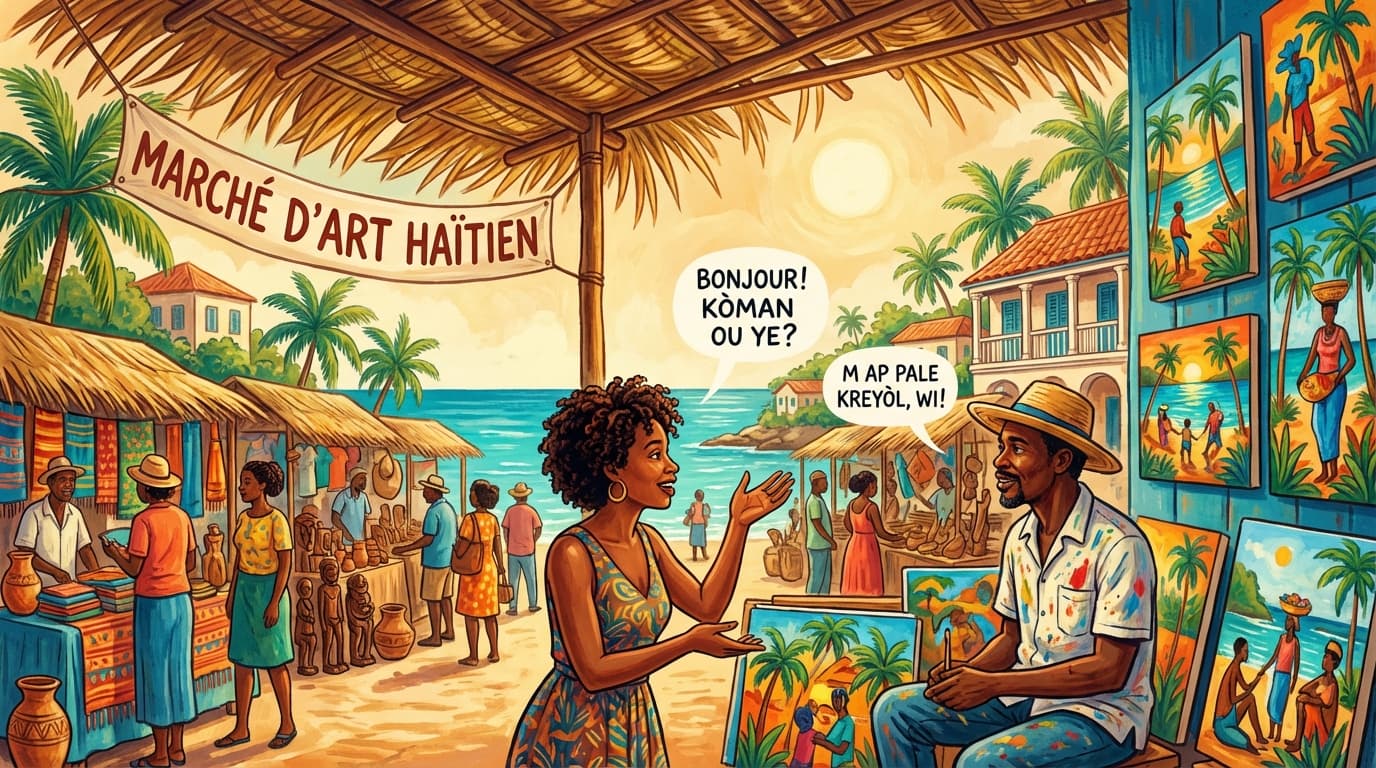
Why Learn Haitian Creole for Travel?
Haiti is the Caribbean's most culturally distinctive country — the world's first Black republic, with a unique blend of African, French, and indigenous influences visible in its language, music, religion, and cuisine. French may be an official language, but Kreyol is the soul of Haiti. Speaking it, even at a basic level, demonstrates respect and creates connections that no other gesture can match.
Creole Grammar Made Simple
Haitian Creole has remarkably simplified grammar compared to French. Verbs don't conjugate — 'mwen pale' (I speak), 'ou pale' (you speak), 'li pale' (he/she speaks). Tense is indicated by particles before the verb: 'mwen te pale' (I spoke — past), 'mwen ap pale' (I am speaking — present progressive), 'mwen pral pale' (I will speak — future). There are no gendered nouns and no complex agreement rules. This makes functional Creole very achievable.
Haitian Food
Haitian cuisine is bold, spicy, and deeply flavourful. Griot (twice-cooked fried pork) is the signature dish — marinated in citrus and spices, then fried until crispy. Diri ak pwa (rice with bean sauce) accompanies nearly every meal. Soup joumou (pumpkin soup) is served every January 1st to celebrate independence. Lambi (conch), tassot (fried goat), and akra (malanga fritters) are all worth seeking out. Haitian coffee is excellent and often underappreciated.
Essential Phrases
| Phrase | English | Pronunciation |
|---|---|---|
| Bonjou | Hello / Good morning | bon-ZHOO |
| Bonswa | Good afternoon / evening | bon-SWAH |
| Koman ou ye? | How are you? | KOH-mahn oo yeh |
| Mesi | Thank you | MEH-see |
| Souple / Tanpri | Please | SOO-play / tahn-PREE |
| Wi / Non | Yes / No | wee / nohn |
| Kote...ye? | Where is...? | koh-TEH...yeh |
| Konbyen? | How much? | kohn-BYEN |
| Mwen pa konprann | I don't understand | mwen pah kohn-PRAHN |
Dining & Restaurant Phrases
| Phrase | English | Pronunciation |
|---|---|---|
| Kont la, souple | The bill, please | kohnt lah, SOO-play |
| Li bon anpil! | It's very good! | lee bohn ahn-PEEL |
| Dlo, souple | Water, please | dloh, SOO-play |
| Yon bye, souple | A beer, please | yohn byehr, SOO-play |
| Mwen gen aleji ak... | I'm allergic to... | mwen jen ah-LEH-jee ahk |
Emergency Phrases
| Phrase | English | Pronunciation |
|---|---|---|
| Anmwe! | Help! | ahn-MWEH |
| Mwen bezwen yon dokte | I need a doctor | mwen behz-WEN yohn dok-TEH |
| Rele polis | Call the police | reh-LEH poh-LEES |
| Kote lopital la? | Where is the hospital? | koh-TEH loh-pee-TAHL lah |
Cultural Notes
- •Haitian Creole is not 'broken French'. It's a fully developed language with its own grammar, vocabulary, and literature. Treating it as proper language shows respect for Haitian culture.
- •Haitians are extraordinarily resilient and proud people. Engage with curiosity and respect, and you'll find warmth and generosity that defines the culture.
- •Griot (fried pork) with diri ak pwa (rice and beans) is the national dish. Haitian food is flavourful and spicy — Scotch bonnet peppers appear in many dishes.
- •Music is central to Haitian culture. Kompa (konpa) is the national dance music — if you hear it, join in.