
Hurtigruten Cruise Guide
Last updated March 29, 2026
Hurtigruten has been sailing the Norwegian coast since 1893 — long before cruising was a holiday concept. Today, Hurtigruten operates expedition cruises to Norway, the Arctic, Antarctica, and beyond. Their ships are working vessels and purpose-built expedition ships, offering authentic adventure, science-led excursions, and destinations at the edges of the world.
What Makes Hurtigruten Different?
Hurtigruten is not a traditional cruise line. The Norwegian Coastal Voyage is a 130-year-old working route — the ships carry mail, freight, and local passengers between 34 ports along Norway's dramatic coastline. Tourists ride alongside locals commuting between fjord villages. It's authentic in a way that no purpose-built cruise ship can replicate.
The expedition ships are purpose-built for polar and remote destinations. MS Fridtjof Nansen and MS Roald Amundsen are the world's first hybrid-powered expedition ships. Expedition teams include marine biologists, glaciologists, historians, and photographers who lead landings and lectures. Science and sustainability are central to the experience.
How Does Hurtigruten Handle Port Days?
The coastal voyage stops at 34 ports — some for 15 minutes (just enough to watch cargo loading), others for several hours (Trondheim, Tromsø, the Lofoten Islands). The variety is extraordinary: tiny fishing villages, university cities, and remote Arctic settlements.
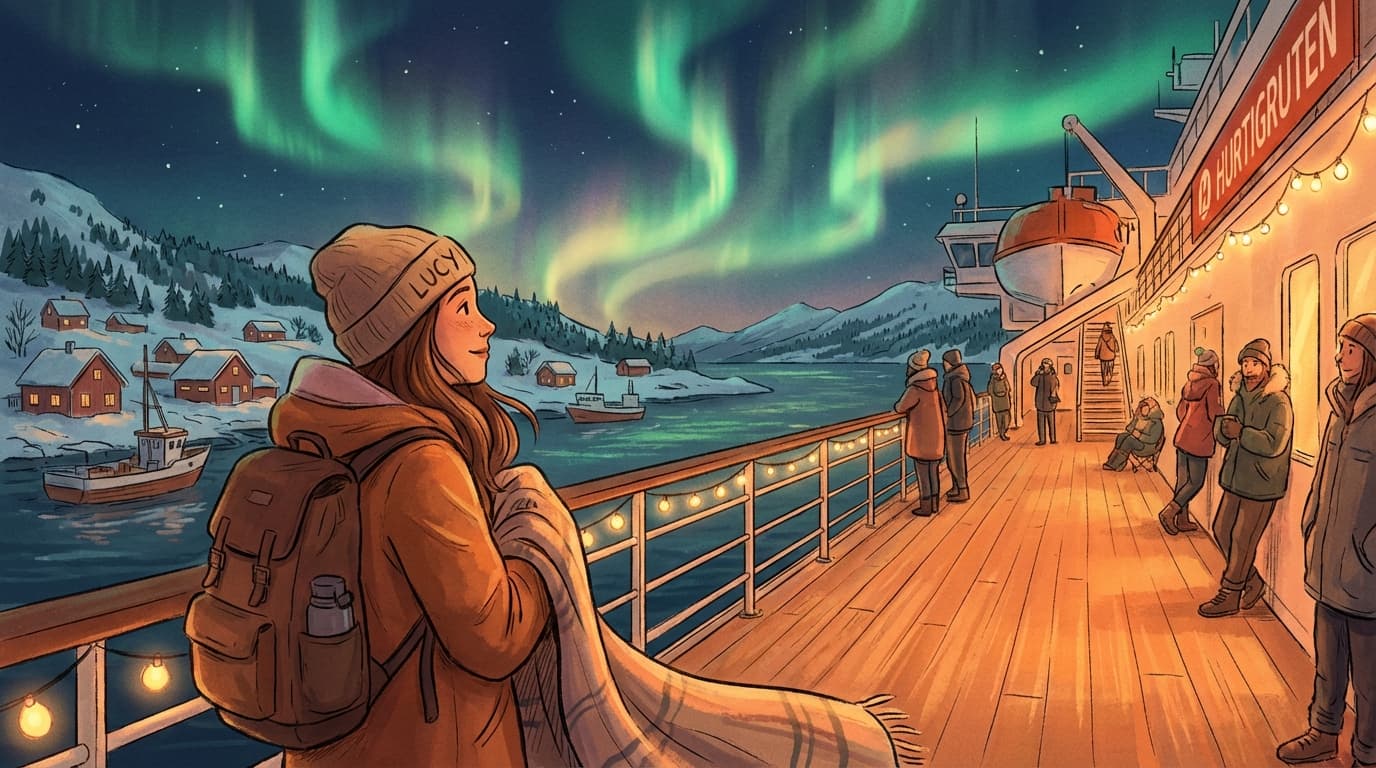
Winter highlight: The coastal voyage runs year-round. Winter sailings (October-March) offer Northern Lights viewing from the ship's deck. Summer sailings (June-August) feature the Midnight Sun — 24 hours of daylight above the Arctic Circle. Both are extraordinary, and Lucy helps at Norwegian ports where English signage varies.
Who Sails Hurtigruten?
Hurtigruten attracts nature enthusiasts, adventure travellers, and Norwegians themselves (the coastal voyage is part of Norwegian identity). Expedition passengers tend to be well-travelled, curious, and comfortable with unpredictability — weather determines the itinerary in polar regions. The atmosphere is informal, intellectual, and focused on the natural world.
How Lucy Helps on Hurtigruten Cruises
Hurtigruten's Norwegian coastal voyage passes through communities where Norwegian is the primary language. Lucy translates harbour-side restaurant menus, reads local signage at fishing villages, and helps you communicate at markets in Tromsø and Bergen. The onboard atmosphere is multilingual (Norwegian, English, German), and Lucy bridges any gaps. For expedition voyages to Greenland and Arctic Canada, Lucy translates Inuit cultural information and signage. In Svalbard, even the safety signs about polar bears are in Norwegian — Lucy reads them all.
Popular Itineraries
Norwegian Coastal Voyage (Full)
Ports: Bergen, Alesund, Trondheim, Bodo, Lofoten, Tromso, Honningsvag (North Cape), Hammerfest, Kirkenes
Svalbard Explorer
Ports: Longyearbyen, Svalbard archipelago (multiple landings, polar bears, glaciers)
Antarctica Discovery
Ports: Ushuaia, Drake Passage, Antarctic Peninsula (multiple landings), South Shetland Islands
Northwest Passage
Ports: Kangerlussuaq (Greenland), Baffin Island, Arctic Canada, Nome (Alaska)
Dining On Board
Main Dining
The restaurant serves Norwegian-inspired cuisine featuring local ingredients — fresh fish from the day's port, reindeer, cloudberries, and Norwegian brown cheese. The food reflects the destination rather than international cruise standards. On the coastal voyage, local suppliers deliver fresh produce at each port stop.
Specialty Restaurants
Expedition ships feature Lindstrom (fine dining, included), Fredheim (casual, included), and Aune (bistro). The Norwegian coastal ships have a single restaurant with regional menus. All dining is included. The food philosophy emphasises sustainability and local sourcing.
Dietary Accommodations
Hurtigruten accommodates dietary needs with Scandinavian pragmatism. Inform the kitchen at embarkation and they'll adapt menus throughout. Norwegian cuisine is naturally rich in fresh fish, root vegetables, and berries. Gluten-free and dairy-free options are available. The focus on whole, local ingredients makes accommodations relatively straightforward.
How Lucy Helps on Hurtigruten
- •Read Norwegian signage, restaurant menus, and transport information at the 34 stops along the coastal voyage
- •Understand Norwegian and German onboard announcements on the multilingual expedition ships
- •Translate informational signs at remote Arctic ports and research stations
- •Navigate Norwegian coastal towns independently during longer port stops
- •Read Inuit cultural displays and signage in Greenland and Arctic Canada